← Essays · November 20, 2026 · 15 min read
Ancestry Story Book: Turn Family History Into Stories
An ancestry story book gives the people in your family tree a voice. Learn how to gather stories, caption photos, and turn them into a keepsake book.
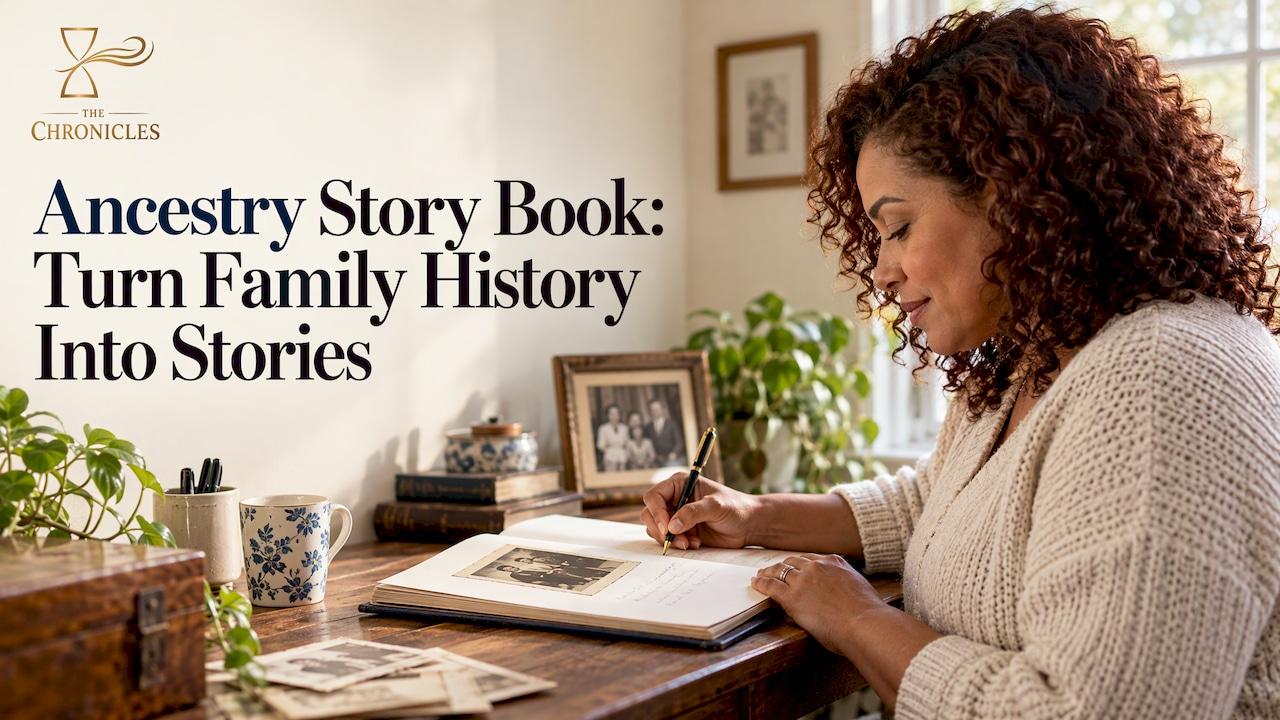
Ancestry Story Book: Turn Family History Into Stories
An ancestry story book is a family history told through the people in it: their voices, their photos, their kitchens and hard years, not just names and dates on a chart. The simplest way to make one is to collect short memories and photos from the relatives you love, let each one become a chapter, and print the result. That is what The Chronicles is built for: it turns photos and short memories into written chapters, lets relatives contribute by email without logging in, and prints the finished chapters as a book.
If you have ever opened a family tree and felt that something was missing, this guide is for you. We will walk through what an ancestry story book is, how to gather stories (including from relatives who are older or living with memory loss), how to organize and caption what you collect, and how to keep it private and in the family.
TL;DR
- An ancestry story book is the stories behind a family tree: the lives, places and voices that give the names meaning.
- Start small. One relative, one photo, one question at a time works better than trying to document everything.
- Ask open, specific questions, keep sessions short, and let the person lead. It is their story, not yours.
- Caption every photo with who, where and roughly when, and mark what you do not know instead of guessing.
- The Chronicles turns photos and short memories into chapters, supports guided email interviews, offers real voice narration, and prints paperback and hardback books.
Table of Contents
- What an ancestry story book is (and what it is not)
- Who this book is for
- Start with one person and one question
- How to gather stories people actually want to tell
- When the relative is older, tired, or living with memory loss
- Organize what you collect into chapters
- Doing the writing without being a writer
- Baby books, memorial books and legacy books use the same method
- Share it, print it, keep it private
- What it costs on The Chronicles
- Our point of view
- Start your first chapter
- FAQ
- Sources
What an ancestry story book is (and what it is not)
A family tree tells you who descended from whom. Genealogists research, record and map those relationships. A personal history does something different: according to the Association of Professional Genealogists' life story peers at the Life Story Professionals, stories around births, deaths and marriages are the leaves that give life to the tree, and a personal history adds color to the people portrayed rather than focusing strictly on the tree itself.
That is the heart of an ancestry story book. It can include a few verified facts, such as where your great-grandmother was born, but the pages are about her: the dress she saved for, the smell of the boat, the thing she said when someone asked how she was.
A few ways to picture the difference:
| Family tree | Ancestry story book | |
|---|---|---|
| Main question | Who came from whom? | What was their life like? |
| Built from | Records, charts, dates | Memories, photos, voices, keepsakes |
| Reader feels | Informed | Connected |
| Who can contribute | Mostly the researcher | Everyone in the family |
You do not need to choose. A tree gives your book a spine, and the stories fill it out. But if you are not a researcher and never plan to be, you can still make something your grandchildren will treasure.
Who this book is for
People arrive at this project from very different places, and the right approach shifts with each.
- Grandparents who want to leave their own story in their own words.
- Adult children who realize they have never heard how their parents met, or what their parents' parents did for work.
- Children of parents in a nursing home or memory unit, who want to hold on to what is still reachable.
- Families who have just lost someone, and want a memorial book that sounds like them.
- New parents, who want a baby book that grows into a family chronicle.
- Scrapbookers who have boxes of photos and no time to write a caption for every one.
The common thread is the same: the stories are in people's heads and in shoeboxes, and they are easier to save today than next year.
Start with one person and one question
The biggest reason these projects stall is scope. "Document the whole family" is not a task anyone finishes. "Ask Grandma about her first job" is.
The National Archives' getting started toolkit for genealogy suggests starting with yourself and working backward. It recommends recording basic facts such as full names, important dates, places, education, occupations and religion, along with personal anecdotes, then contacting relatives respectfully, taking accurate notes, respecting privacy and documenting your sources.
For a story book, that translates into a simple first pass:
- Write down what you already know about yourself and your parents in a few lines each.
- Pick the one relative whose stories you are most afraid of losing.
- Choose three photos connected to them.
- Write one question for each photo.
That is your first chapter. Everything else grows from it.
How to gather stories people actually want to tell
Prepare the person, not just the questions
American Ancestors recommends sending your question list to the relative in advance so they have time to remember and prepare. It also suggests recording answers with a phone or recorder, using photos and objects as memory triggers, and being thoughtful with sensitive subjects. With a veteran, for example, you might ask whether they were in any battles but add that they should only share what feels comfortable.
Ask open, specific questions
The Native Oral History interviewing guide advises clear, concise, open-ended questions that begin with "how" or "what" rather than "do" or "did," and follow-ups such as "Could you explain?" or "Can you give me an example?" It also suggests family-folklore prompts about the family name, naming traditions and how the family first came to the United States. Those last ones are gold for an ancestry book.
Some starting points:
- How did our family name come to us, and what do you know about where it began?
- What do you remember about the house you grew up in?
- What was a normal Sunday like when you were ten?
- Whose cooking do you still think about?
- Which object in this house has a story, and what is it?
According to Time's January 2026 interview guide, Suzanne Russo Adams of Brigham Young University's Center for Family History and Genealogy says facts are not what you are after. Invite storytelling, listen more than you talk, and follow the emotion rather than the timeline. Early memories tend to bring up the things that stick.
Elizabeth Keating, a University of Texas at Austin anthropologist, suggests sensory follow-ups in The Atlantic. After asking about a childhood home, ask what the windows looked out onto and what the person heard when waking up. She also calls "What do you wish people knew about you?" one of the best plain questions you can ask.
Record it in a way that feels easy
A phone propped on the table is enough. If you want to go further and make the recording clearer, these interview questions for video show how to shape questions so the answers come out clear and usable. And if you would rather hear your relatives than read them, an audio memory book keeps stories in their own voice.
For a step-by-step method, our guide to conducting an oral history interview with your family covers the whole session from setup to follow-up.
When the relative is older, tired, or living with memory loss
This is where many of our readers are, and it deserves a gentler pace.
Dementia UK's life story leaflet recommends leading with the person's wishes and taking one topic at a time at their own pace, which might be days, weeks or months. It suggests photos, videos and familiar music as prompts, involving children and grandchildren, and keeping the life story "live" so that it can be updated. It also suggests a fuller version for family and a shorter one for carers. Its guiding idea is that the story belongs to the person: use their own words as captions.
The gerontology article in Caring for the Ages adds practical rules for sessions:
- Keep each one under an hour.
- Spread interviews over several weeks.
- Do not push if the person is agitated or unwell.
- Ask from genuine curiosity, and avoid yes/no and "why" questions.
It also notes that sharing memories can be tiring, and that your role is an empathetic listener. If a loved one says something surprising, a shocked reaction can end the story. Feeling safe is what produces depth.
If your parent is in a nursing home or memory unit, you do not have to hold the whole project yourself. Short photo-led visits, one memory at a time, add up to a real book. Our guide to the best ways to record a grandparent's life story shows several gentle options.
If a relative is not comfortable with apps, The Chronicles supports guided email interviews: questions arrive in their inbox and they reply in their own words, with no login to remember. Those replies become part of the book.
Organize what you collect into chapters
A pile of photos and voice notes becomes a book when you give it a shape. Here is a simple structure that works for most families:
- A short opening page. Who the book is for and who contributed.
- One chapter per person, place or era. "Grandpa Joe's Garage," "The Farm on County Road 9," "The Year We Moved."
- A photo or two in each chapter, with a caption that carries the story.
- A family tree or timeline page if you have the facts for it.
- A few blank pages at the end for stories that arrive later.
Chapters should be small. A single photograph and 150 to 300 words can carry a whole afternoon from 1962. If you are working from boxes of old prints, our walkthrough on how to turn old family photos into a book shows how to sort them without losing a weekend.
Caption like a family historian
The best captions answer three things: who is pictured, where, and roughly when. Name people left to right. If you are not sure of a date or a name, say so in the caption ("about 1958, aunt not yet identified") rather than guessing. A guess printed in a book tends to harden into fact, and your descendants will repeat it.

Verified facts can sit alongside the stories. A birth year from a record next to a grandmother's memory of the day is exactly the combination that makes an ancestry book feel both true and alive.
Doing the writing without being a writer
Most families have the stories but not the hours or confidence to write them up. This is where The Chronicles helps: you add a photo and a few lines of memory, and our AI turns them into a written chapter you can edit and make your own. You can also add real voice narration, including consented voice cloning, so a chapter can be heard as well as read.
If you would like to see how that works from a single image, try the photo to story app. If you are weighing it against making your own scrapbook, the digital family scrapbook guide and our page on writing your life story from photos show the same approach in more detail.
Baby books, memorial books and legacy books use the same method
The structure above does not change when the occasion does.
- A baby book is an ancestry story book that starts at the beginning. Add the pregnancy photos, the day-one story, and short notes from grandparents about who the baby takes after. Later chapters can follow first steps, first words and first trips to see relatives.
- A memorial book is the same book, begun when you most want to hold on. Gather photos and the stories relatives tell about the person: the jokes, the habits, the way they signed a card. Invite everyone who knew them to add a memory, and do not worry about polish. If you are grieving, go slowly and take the chapters one at a time.
- A legacy book grows over years, with new chapters as the family grows. Our family legacy book page shows how chapters from many relatives live together in one place.
If you are building a book of history for the whole family tree rather than one person, see our family history book page.
Share it, print it, keep it private
A family story book is personal. Before you share anything, tell relatives how their words and photos will be used, and ask permission before recording or sharing them. Letting people see and correct their own chapters before the book goes out builds trust, and it usually makes the stories better.
Privacy is where we hold a firm line. At The Chronicles, stories are never used to train AI, they stay within your family, and you own your stories with easy export. There are no ads and no lock-in. Relatives can contribute through guided emails without creating a login.
When you are ready to hold the book, you can order a print edition: paperback from $49 or hardback from $99, one-time prices on our book page.
What it costs on The Chronicles
The Chronicles offers a free plan at $0, the Chronicle plan at $7 per month and the Family plan at $15 per month, with free trials available. Paid plans include unlimited chapters, AI assistance, narration and print book ordering, with physical books paid for separately. You can see the details on our pricing page.
Our point of view
Every family I know has the same regret: not asking sooner. The photos are there, but the stories behind them live in a handful of people, and they are not written anywhere.
We built The Chronicles around a simple belief. A family's history is not a database. It is a set of small, specific moments told by the people who lived them, and it should be easy for anyone, from a ten-year-old to an eighty-year-old, to add one.
That is why chapters start from a photo and a few words, why relatives can reply by email, and why voices can be heard as well as read. It is also why your stories stay yours: never used to train AI, always exportable, and never behind ads.
Start with one chapter this week. The book will find its shape.
Kevin
Start your first chapter
If you are ready to begin, The Chronicles lets you start free, add your first photo and memory, and see it become a chapter. When the book feels ready, you can print it as a paperback or hardback keepsake.
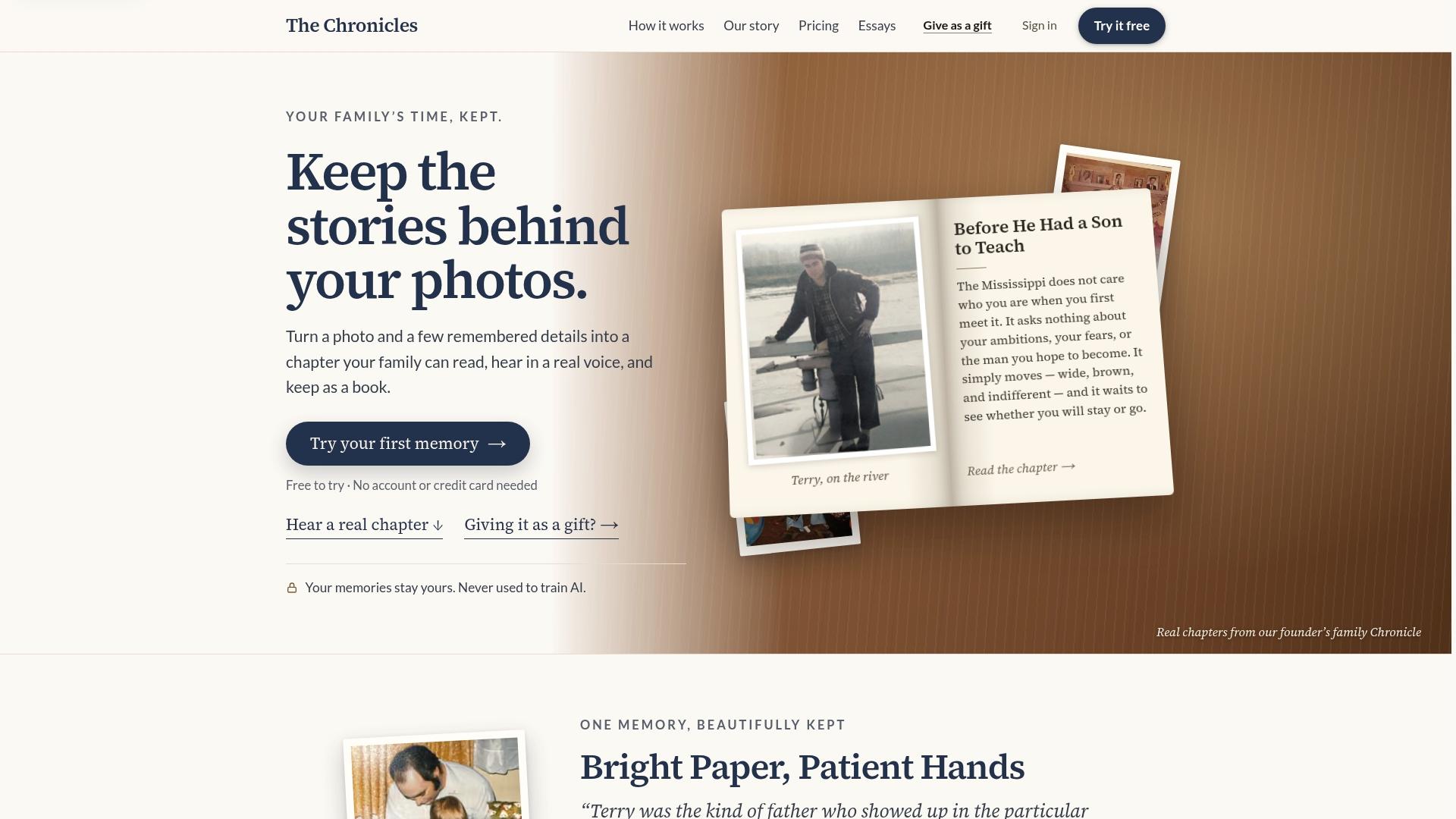
Start your family chronicle or see how the printed book looks.
FAQ
How is an ancestry story book different from a genealogy book?
A genealogy book maps who descended from whom, using records and charts. An ancestry story book focuses on the lives of the people, with their memories, photos and voices, and can include a few verified facts for context. Many families use both: the facts give the stories their place.
What should I put in the first edition?
Keep it small. A single relative, a handful of photos with captions and a few short chapters is a complete first book. Add a contents page and a note about who contributed, and leave blank pages at the end for what comes later.
How do I collect stories from a relative with memory loss?
Let them lead, use photos and familiar music as prompts, and take one topic at a time. Keep sessions short and spread them over weeks, as the dementia and oral history guidance above recommends. If their memory is a particular concern, talk with their care team about what to include and how to approach it.
Can relatives contribute if they are not comfortable with technology?
Yes. With The Chronicles, guided email interviews let a relative answer questions by replying to an email, with no login. Their answers can become chapters in the shared book.
Can I make the book a gift?
Yes. Many families build a book for a parent, grandparent or new baby. Our grandparent memory book page is a good place to begin.
Sources
- Frequently Asked Questions, Life Story Professionals
- Conducting a Family History Interview, American Ancestors
- Creating a life story for a person with dementia, Dementia UK
- Conducting Oral Histories, Caring for the Ages
- Interviewing Guide, Native Oral History
- 10 Meaningful Questions to Ask the Older People You Love, Time
- The Questions We Don't Ask Our Families but Should, The Atlantic
- Getting Started genealogy toolkit, National Archives
Recommended
From the founder
Start your first chapter — three minutes, no account.
Drop in a photograph of someone you love. Write three sentences about a moment with them. The Chronicles writes the chapter.
Try it free →Questions or thoughts? kevin@thechronicles.life — I read everything.