← Essays · November 16, 2026 · 14 min read
Audio Memory Book: Keep Family Stories in Their Own Voice
An audio memory book pairs written chapters and photos with the real voice of someone you love. Here is how to record, organize and print one.
Audio Memory Book: Keep Family Stories in Their Own Voice
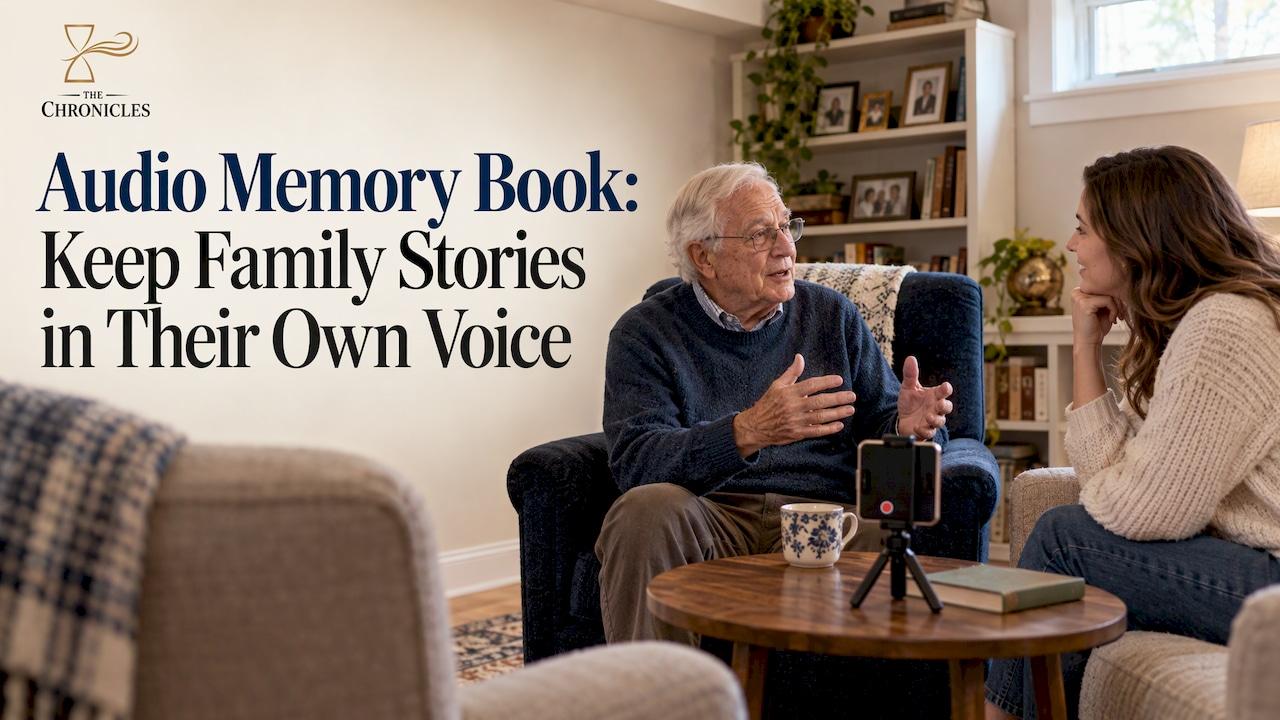
An audio memory book is a keepsake where the stories on the page can also be heard in the voice of the person who told them. You record a memory, pair it with a photo, shape it into a chapter, and keep the sound alongside the words. The simplest way to start is to pick one person, one photo and one question, and let the recording run. On The Chronicles, each chapter can be heard aloud, and you can start free.
Photos show what someone looked like. Words show what happened. Only a voice carries the laugh before the punchline, the pause before a name, the way a grandmother says "honey." That is what an audio memory book is for.
TL;DR
- An audio memory book combines written chapters, photos and real voice recordings, so family can read and hear the same story.
- You do not need special equipment: a phone, one open question and a quiet room are enough to begin.
- For a parent with dementia or in memory care, keep sessions short, ask permission each time and follow their lead, not the facts.
- Name, back up and store recordings in more than one place, or the stories can be lost with a single device.
- The Chronicles turns photos and short memories into narrated chapters. The Free plan costs $0, Chronicle is $7 per month, Family is $15 per month, and print books start at $49.
Table of Contents
- Why a voice changes a memory book
- What goes into an audio memory book
- How to record stories by voice, step by step
- Recording with a parent in memory care or with dementia
- Baby books, memorial books and family histories
- Privacy, consent and keeping recordings safe
- How an audio memory book compares with the other ways to keep stories
- Start your audio memory book
- Our perspective
- FAQ
- Sources
Why a voice changes a memory book
Most families have photos and a few written notes. Then someone is gone, and what they miss is the sound. Aging expert Amy O'Rourke told WEAU in April 2026 that after her mother died, the family had everything written down and plenty of pictures, but somehow the voice was missing.
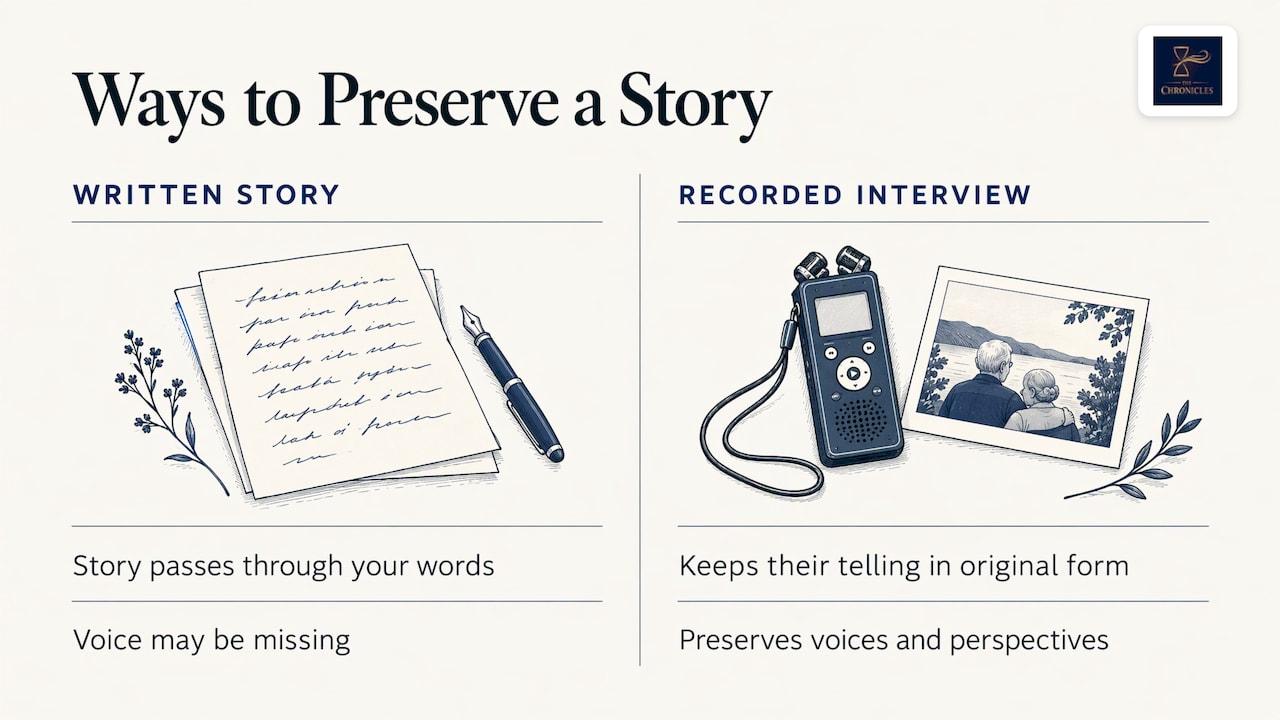
The Smithsonian's oral history guide describes recorded interviews as a way to preserve the voices, memories and perspectives of people, and notes that a recording keeps the whole telling in its original form instead of someone else's summary. That is the heart of it. When you write a story from memory, it passes through your own words. When you record it, you keep theirs.
There is also a benefit while your loved one is still here. Guideposts reports that reminiscing and storytelling with a loved one can support their mental, psychological and emotional health. And AARP notes that many people find the act of recording more rewarding than the finished product. The afternoon at the kitchen table is part of the gift.
What goes into an audio memory book
An audio memory book has three layers. You can build all of them, or begin with one and add the others over time.
- The voice. The raw recordings: a story told over coffee, a phone call, a answer to a question you sent.
- The words. A written chapter shaped from what was said, so the story can be read, searched and printed.
- The photos. The pictures that give each story a face, a place and a year.
The Chronicles is built around exactly this mix. You turn photos and short memories into written chapters, add real voice narration, and later order a printed book. Our Voice Memory Book page shows how a chapter sounds when it is read aloud. If your starting point is the pictures, the photo to story app turns one photo into one chapter.
Real voice or a cloned voice
The Chronicles offers real voice narration, and, with consent, voice cloning. Real voice is the recording of your grandfather telling it himself. A consented cloned voice lets a chapter be narrated in a voice the family chooses to preserve, with the person's agreement. Either way, the decision belongs to the storyteller and the family.
How to record stories by voice, step by step
Here is a routine that works whether you use a phone alone or a full platform.
Step 1: Choose one person and one story
Do not start with "tell me about your life." When I Die Files points out that this kind of huge opening question freezes most people. Start small: the first car, the house you grew up in, the day a child was born.
Step 2: Ask open questions
Questions that cannot be answered with yes or no draw out the best stories. AARP describes a family who used AI to draft a first set of questions before recording a 92-year-old cousin, and suggests prompts such as the first thing you remember about moving somewhere new. HelpDementia.com suggests a single open prompt, like what Sunday morning was like in childhood, and then letting the person lead.
The Smithsonian notes that a well-prepared, empathetic interviewer helps people share things they did not realize they remembered. Listen more than you talk, and let silences stand. Our guide to conducting an oral history interview with your family goes deeper on question order and follow-ups.
Step 3: Record with what you have
A recent smartphone microphone is good enough. Put the phone on something soft within about a meter of the speaker and choose a quiet room. If you are far apart, the University of Cincinnati's life stories guide describes a five-step Zoom method: check the microphone, start a meeting with local recording, talk through early life, family and career, and reflections, end the meeting, and save the audio file.
Step 4: Include relatives who are not tech-savvy
Not everyone wants an app, a login or a password. The Chronicles supports guided email interviews, so a parent or aunt can answer questions in their own time without creating an account. You can then add their memories to the chapter, with their voice or their words, and the whole family can contribute to one shared story.
Step 5: Name everything as you go
The most common failure is not poor sound. It is twenty files named "Voice Memo 14" that nobody can identify a year later. Name each recording with the person, the topic and the date, for example "Grandma Ruth, the farm, 2026." Better still, attach it to a photo and a chapter right away, so the context is never lost.
Step 6: Turn it into chapters
Let the recording become a chapter: a title, a few paragraphs, a photo, and the voice beside it. With The Chronicles, AI assistance helps turn photos and short memories into written chapters, and you can keep adding to the same Chronicle over months and years. See how the AI memoir writer works if you would like help with the writing.
Step 7: Print it
A printed book is the part that sits on the coffee table. The Chronicles offers Paperback books from $49 and Hardback books from $99, one-off, on the book page. Print what you have now. A Chronicle can keep growing afterward.
Recording with a parent in memory care or with dementia
If your mother or father lives in a nursing home or memory unit, the goal changes. You are not collecting a perfect timeline. You are catching moments while they can still be caught.
HelpDementia.com advises these habits:
- Invite the person to lead, and keep each session short and low-pressure.
- Ask permission before each recording.
- Allow pauses and unfinished thoughts, and avoid correcting details.
- Stop if the conversation brings distress, frustration or tiredness.
Its author Steve Levine puts the aim simply: hear what matters to them, not whether names and dates are right. A remembered song, a joke or a feeling carries meaning without a complete chronology.
There is research behind making these keepsakes. A Hamilton Aging Together research chapter notes that in long-term care, people with dementia most often need their stories written down or recorded for them. It also reports that life story books with images and short sentences have been shown to increase factual statements and help conversations stay on topic. Staff and family can use the person's own recorded words and phrases to start future conversations.
If you are worried about a parent's health, memory or distress during these sessions, talk with their doctor or care team, who know their situation. For the keepsake itself, the grandparent memory book page and our guide on the best ways to record a grandparent's life story are good places to begin.
Baby books, memorial books and family histories
The same idea fits very different moments.
- A baby book. Record the first words, a lullaby, a sibling's silly story about the new baby. Years from now, a child can hear what the house sounded like.
- A memorial book. After a loss, voice recordings gathered from relatives and friends can sit beside photos in one place. Our memorial memory book page is for families building exactly that, and old voicemails or recorded toasts can become part of a chapter.
- A family history. Layer stories from several relatives about the same event, so you hear each version. The family history book page shows how.
- A scrapbook with sound. If you love albums, pair each page with a story. Our guide to a digital family scrapbook shows how photos become stories.
For a gift, the anniversary memory book is built for stories that grow over years.
Privacy, consent and keeping recordings safe
These are your family's most personal words, so decide how they are treated before you record.
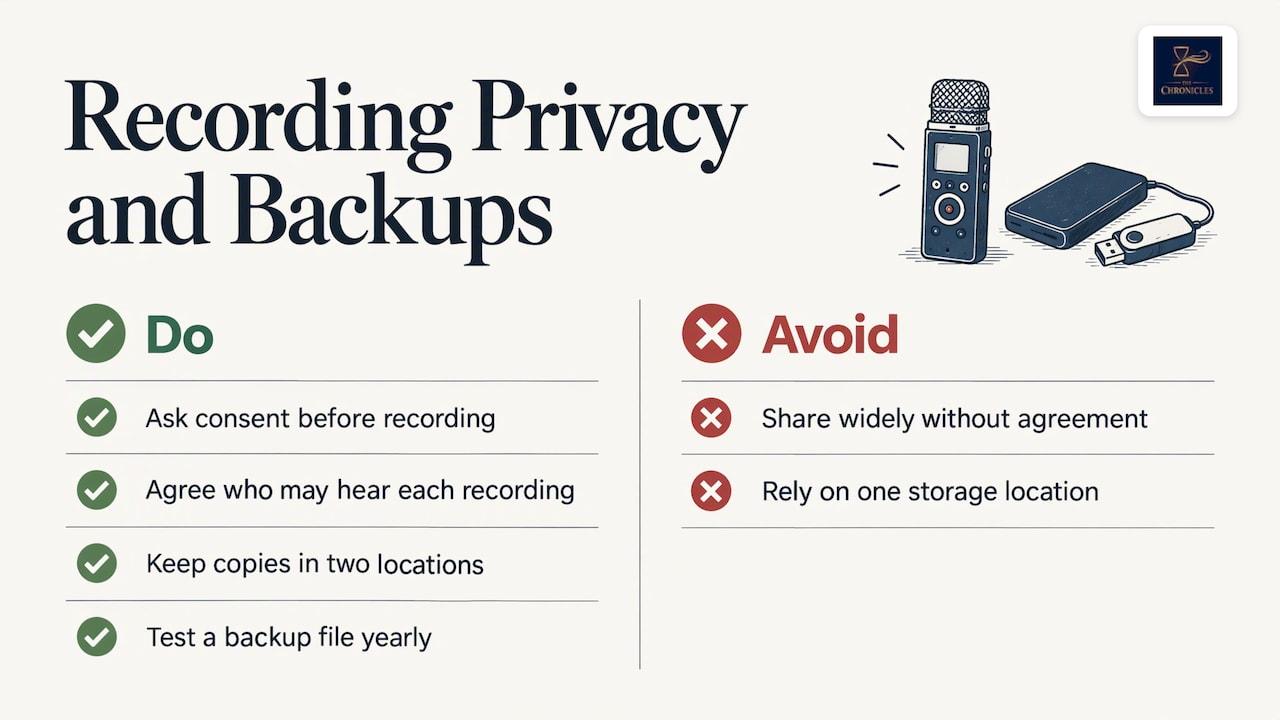
Ask for consent, and talk about the future. When I Die Files suggests asking the storyteller what should happen to their recordings ten years from now. Some people are happy for grandchildren to hear them, while others are uncomfortable with their voice being shared widely. Decide together who hears what.
Know what happens to the stories. We never use family stories to train AI. Your stories remain yours, with full ownership and easy export, no lock-in and no ads.
Keep copies in more than one place. The Library of Congress digital preservation guidelines, as summarized by When I Die Files, recommend common formats such as MP3, MP4 and PDF, kept in at least two separate locations. Cohesion Lab's family archive checklist adds that you should open a random file from your backup once a year to confirm it truly works.
How an audio memory book compares with the other ways to keep stories
Families usually choose between a few kinds of keepsakes. A written memoir gives structure and careful wording. A phone recording captures voice quickly. A recordable photo album gives a physical object with short clips. An audio memory book on The Chronicles brings these together: written chapters, photos, narration and a printed book, in one place that several relatives can add to.
The University of Cincinnati handout notes that audio captures voice, personality and inflection, and that it is natural, conversational and easy to begin. The Chronicles adds the structure on top: each recording becomes a titled chapter tied to a photo, so nothing sits in a folder unnamed.
| What you want | How The Chronicles helps |
|---|---|
| A voice you can hear | Real voice narration, or consented voice cloning |
| Relatives who avoid apps | Guided email interviews, no logins needed |
| Stories shaped into chapters | AI assistance from photos and short memories |
| A book to hold | Paperback from $49, Hardback from $99 |
| Keep adding over time | Chapters from multiple family members, ongoing |
| Control of your stories | Full ownership, easy export, never used to train AI |
Start your audio memory book
The Chronicles has a Free plan at $0, a Chronicle plan at $7 per month and a Family plan at $15 per month, with unlimited chapters, AI assistance, narration and print book ordering on the paid plans. Printed books are paid for separately, from $49 for Paperback and from $99 for Hardback. You can try it first with a free trial.
Choose one photo, one question and one person. Record a first story this week, then add the next when the family is together again.
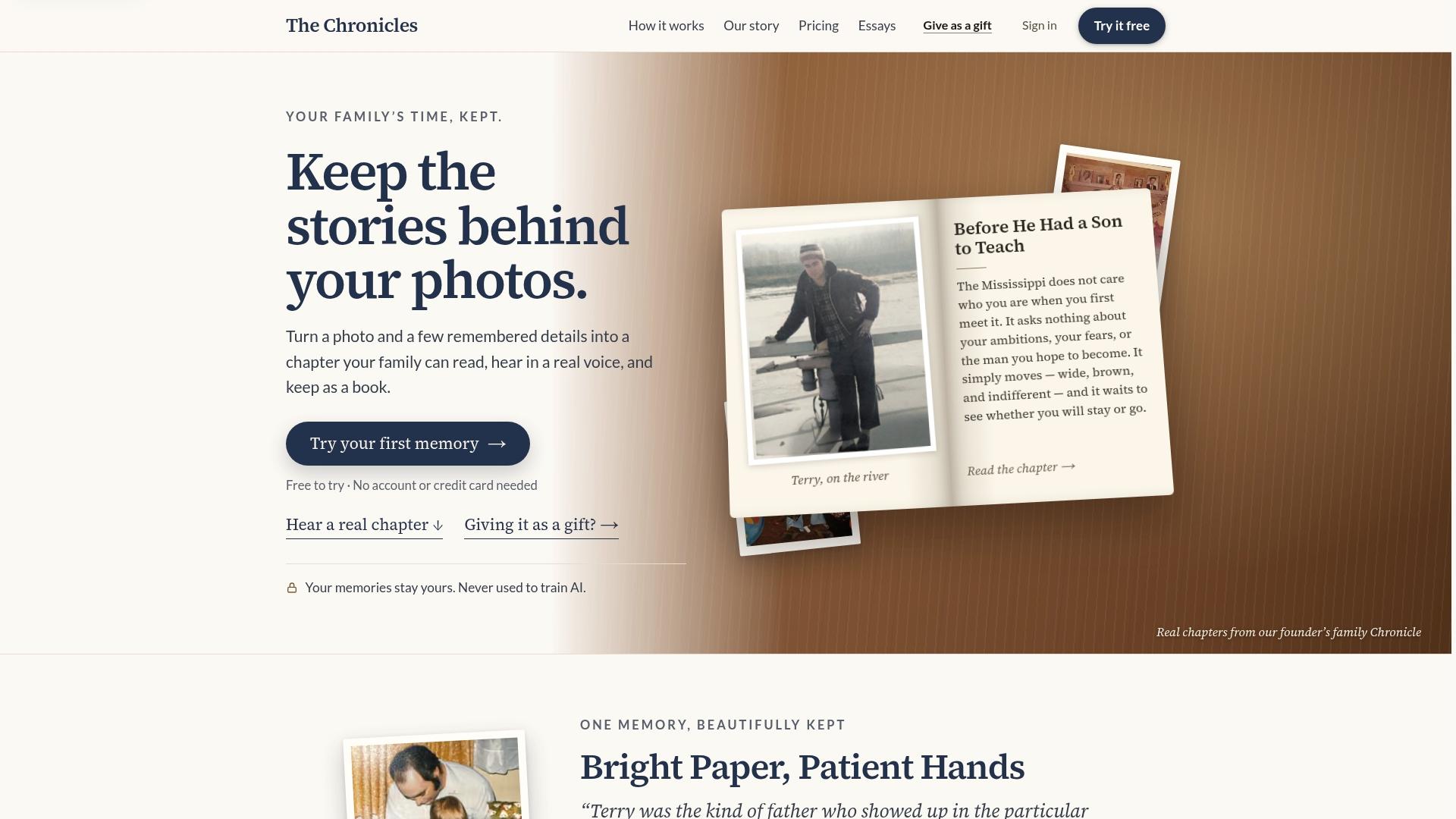
Begin on our plans page or go straight to The Chronicles and create your first chapter.
Our perspective
We started The Chronicles because the stories behind a photo are usually the first thing a family loses. The picture survives. The names, the jokes and the sound of someone's voice telling it do not.
We believe a memory book should be heard as well as read. That is why every chapter can carry real narration, and why we built guided email interviews: your grandfather should not need a password to be part of the family record.
We also believe the stories belong to the family and nobody else. Ours are never used to train AI, you own what you write, and you can export it whenever you like.
Start with something small. One photo, one story, one voice. The rest of the book grows from there.
Kevin
FAQ
What is an audio memory book?
It is a keepsake that combines written family stories and photos with recordings of the people who told them. You can read the story, then press play and hear it in their own voice. On The Chronicles, narrated chapters can also become a printed book.
What is the easiest way to record stories by voice?
Use a smartphone in a quiet room, sit close to the speaker and ask one open question, such as what a Sunday morning was like in childhood. Save each recording with the name, topic and year. If a relative lives far away, a video call with recording turned on works well.
Can a relative contribute without an account?
Yes. The Chronicles supports guided email interviews, so relatives who are not comfortable with technology can answer questions by email, with no login. Their memories can then be added to a chapter in the family's Chronicle.
Is it too late if my parent has dementia?
Not at all. Keep sessions short, ask permission each time, follow their lead and stop if they seem tired or upset. A song, a joke or a remembered feeling is worth keeping even without exact dates. Their care team can advise you on what suits their situation.
How much does it cost?
The Chronicles has a Free plan at $0, Chronicle at $7 per month and Family at $15 per month. Printed Paperback books start at $49 and Hardback books at $99, paid one-off.
Sources
- Smithsonian Institution Archives: How to Do Oral History (2020)
- Smithsonian Institution Archives: An Introduction to Oral History
- WEAU: Preserving history, importance of recording older loved ones' family stories
- Guideposts: 4 Methods for Collecting and Preserving Your Loved One's Life Stories
- AARP: How to Capture You or Your Loved One's Legacy
- University of Cincinnati: Preserving Life Stories
- When I Die Files: Best apps for recording family stories in 2026
- HelpDementia.com: Why Dementia Families Record Stories
- Hamilton Aging Together: Overcoming Communication Predicaments of People with Dementia
- Cohesion Lab: A starter checklist for a family archive
Recommended
From the founder
Start your first chapter — three minutes, no account.
Drop in a photograph of someone you love. Write three sentences about a moment with them. The Chronicles writes the chapter.
Try it free →Questions or thoughts? kevin@thechronicles.life — I read everything.