← Essays · November 9, 2026 · 15 min read
Family Heritage Book: How to Create One Your Family Will Keep
A family heritage book gathers your stories, photos and traditions in one keepsake. Learn what to include, how to gather memories, and how to print it.
Family Heritage Book: How to Create One Your Family Will Keep
A family heritage book is a keepsake that brings together the stories, photographs, documents and traditions of your family in one place, so the people who come after you know who came before them. It can be a full genealogy with charts and citations, or it can be something warmer and simpler: a collection of chapters about the people you love. Most families are happiest with the second kind, and it is easier to finish than you might think.
This guide walks you through what belongs in the book, how to collect stories from relatives who are busy or far away, how to handle the tender subjects, and how to protect and print the finished result.
TL;DR
- A heritage book does not have to be a genealogy. Stories about real people, with photos, are what keep readers turning pages.
- Start small: pick one branch, one decade or one person, then add chapters over time.
- Caption every photo with who, where and when, and label anything you are unsure of.
- Back up everything, keep the originals, and ask permission before including living relatives' private moments.
- You can build, narrate and print the book with The Chronicles, starting free.
Table of Contents
- What a Family Heritage Book Really Is
- Choose a Scope You Can Finish
- What to Include in Your Heritage Book
- How to Gather Stories From Relatives
- Handling Private and Sensitive Stories
- Protect What You Collect
- Print It, Share It, Keep Adding
- Our Perspective
- Start Your Family's Book With The Chronicles
- A Simple Plan for Your First Month
- FAQ
- Sources
What a Family Heritage Book Really Is
The phrase covers a wide range. At one end sits the traditional genealogical book, with registers and pedestal charts that trace descent from one ancestor. American Ancestors notes that formats like the register and the Ahnentafel are genealogical conventions, but that not every family history book has to follow one. What every book does need, it says, is narrative: the stories of the people in it.
That is good news if you are not a researcher. Your grandmother's kitchen, the year your father drove across the country, the recipe nobody wrote down until last spring: these are the heart of a heritage book. Names and dates give the stories a frame. The stories are what your grandchildren will actually read.
A heritage book can preserve:
- Life stories told by parents, grandparents, aunts and uncles
- Photographs, old and new, with the context that makes them meaningful
- Documents such as immigration papers, letters, military records, diplomas
- Traditions, including holiday rituals, recipes, sayings and songs
- Places, from the old neighborhood to the family farm
- Tributes to people who have died, in the words of those who loved them
Choose a Scope You Can Finish
Most heritage books stall because they try to hold everything. American Ancestors advises defining a manageable scope and not trying to "do it all," and suggests putting material that does not fit elsewhere into an appendix.
Here are some scopes that work well:
| Scope | Best for | Example |
|---|---|---|
| One person | A grandparent's life story or a memorial | "Grandpa Joe, 1938 to today" |
| One branch | A surname or a set of grandparents | The Delgado side, from Texas to Ohio |
| One era | A decade that shaped the family | The farm years, 1955 to 1972 |
| One theme | Traditions, recipes or travel | Sunday dinners across three generations |
| A growing book | Families who want to keep adding | Chapters from every household, added over years |
None of these is a lesser book. A tight, finished book about one person is worth more than a sprawling one that never leaves a folder. You can always start a second volume.
What to Include in Your Heritage Book
Kentucky Genealogical Society author Susan J. Court describes weaving in memorials collected from relatives, bits of family lore such as recipes, important documents, and as many photographs and visual mementos as you can gather. That is a good checklist for a first draft.
Stories first
Open each chapter with a person or a moment, not a date. "The summer Dad taught me to fish at Lake Erie" pulls a reader in. "Born 1941, Cleveland" can come in the second paragraph.
Short chapters work best. One photo, one memory, one page or two. This also makes the book far easier to write, because you are never facing a blank 200-page manuscript, only the next small chapter.
Photographs with real captions
A photo with no caption becomes a mystery in one generation. For each picture, note:
- Who is in it, left to right for groups
- How they are related to you, if it is not obvious
- Where and when it was taken, even approximately
- What was happening
- Who owns the original
If you are guessing, say so. A line such as "date estimated from the car" or "we think this is Aunt Ruth" keeps the book honest and invites other relatives to correct it. For a deeper walkthrough, see our guide on turning old family photos into a book.
Documents and keepsakes
A scan of a ship manifest, a handwritten recipe card or a wedding invitation adds texture. Place them beside the story they belong to rather than at the back, unless there are too many. In that case American Ancestors suggests putting source citations at the back as endnotes instead of footnotes on every page, so illustrated pages stay clean.
Traditions and everyday life
It is easy to overlook the ordinary. What did Sunday supper smell like? What did Grandma say when she was proud of you? What song did Grandpa hum while he shaved? Years from now, these small details are what readers will treasure most.
Sources, when you have them
If your book includes genealogical claims, say where they came from. American Ancestors puts it plainly: anything that is not common knowledge should be sourced, and you should pick one citation style and stay consistent. For a storytelling book, a short note at the end of a chapter is plenty.
How to Gather Stories From Relatives
The best material lives in people, not in boxes. And people are busy, far away, shy or tired. A few approaches make it easier.
Ask one good question at a time
A blank page is intimidating. A single question is not. JewishGen's interview guide suggests starting with simple facts: where a relative was born, maiden names, where the grandparents were born. It then moves into stories, such as what the family said about why ancestors came to America, and a representative story about a grandmother or grandfather. Follow-ups about meeting a spouse or the family heirlooms often open the longest answers.
Some prompts that tend to work in any family:
- What is your earliest memory?
- What was your first job, and what did it teach you?
- Who in the family do you wish I had met?
- What did we always eat at holidays, and who made it?
- What is a story about you that the family always tells wrong?
Let relatives answer in their own way
Not everyone wants to write. Some will talk for an hour on the phone and freeze at a keyboard. Others do not use apps, or do not want another login. With The Chronicles, a relative can answer guided interview questions by email, with no account needed, and you can add their words to the book. For a parent who prefers to talk, you can also preserve family stories before they are gone with a recording of a phone call and turn it into a chapter later.
Invite the whole family
A heritage book gets richer when more than one person holds the pen. Your aunt remembers the move to Arizona differently than your father does, and both versions belong. A shared book where each household adds its own chapters over the years becomes a living record, which is the idea behind our family legacy book.
When someone cannot tell their own story
Sometimes a parent is in memory care, or a loved one has passed. You can still build the book from what remains: photographs, letters, recipes, and the memories of the people who knew them. Ask siblings, cousins and old friends for one memory each. Even a paragraph is a gift. Many families find that gathering these memories becomes a comfort in its own right.
Handling Private and Sensitive Stories
Every family has chapters that are hard: a divorce, an estrangement, an illness, a loss, a secret that was never discussed. A heritage book is not obliged to include everything, but it should be honest about what it does include.
A few guidelines that careful family historians follow:
- Ask before you include. If a living relative appears in a story that is personal to them, talk with them first and respect their answer.
- Decide who the readers are. A book for your immediate family can hold more than one meant for cousins or for a wider circle.
- Focus on the person, not the wound. You can honor someone's struggle without describing every painful detail. "She raised four children alone and never once complained" says a great deal.
- Consider the next generation. If a story could embarrass or hurt someone still living, leave it out of the main book, or keep it in a private version.
- Share, then edit together. Let relatives read their chapter before printing.
If a story touches on trauma, abuse or serious mental health struggles, consider talking with a licensed counselor or family therapist before deciding how to record it. That is a conversation worth having with a professional, not something a book can settle for you.
Privacy also applies to where the stories are stored. Our promise at The Chronicles is that your family's stories are never used to train AI, and that you keep full ownership of what you write, with easy export.
Protect What You Collect
A book is only as safe as the files behind it. The National Archives recommends digitizing family papers and photographs so you can view and share them without handling the fragile originals, and also recommends keeping the originals, because digital files carry their own risks and can be lost.
A simple routine:
- Scan or photograph old prints and documents.
- Name files clearly. The Buncombe County Special Collections Personal Archiving manual suggests descriptive file names and basic metadata covering who, what, where and when.
- Back up in more than one place. The National Archives describes the 3-2-1 rule: three copies, on two different kinds of media, with one stored off-site.
- Check once a year. The Buncombe County manual advises checking your files annually and creating new copies about every five years, or sooner if needed.
Family Tree Magazine adds that cloud storage can help, but that copies should live in multiple places and on multiple services.
And keep the printed book itself. A paper copy on a shelf needs no password, no battery and no software update.
Print It, Share It, Keep Adding
A heritage book belongs in hands. Once your chapters are ready, a printed copy becomes the version that gets passed around at holidays, tucked into a gift box, or read aloud at a reunion.
Some practical tips:
- Order copies for each household. Siblings and cousins will want their own.
- Choose the cover to match the purpose. A sturdy hardback suits a legacy volume. A paperback is a good fit for sharing widely.
- Proofread together. Names and dates are where mistakes hide.
- Plan for volume two. Families keep making stories, and the book can keep growing.
Our Perspective
We built The Chronicles because we kept seeing the same thing: families who truly wanted to preserve their stories, and a shoebox of photos that never turned into anything.
The obstacle is rarely love or interest. It is time, and it is the blank page. That is why we start with one photo and one short memory, and let each become a chapter. Our AI helps shape what you share into a written story, and you stay in charge of every word.
We also believe the book should be easy for every generation to join. A grandparent who does not want an account can answer guided questions by email. Real voice narration, including consented voice cloning, lets a family hear a story in a familiar voice. And your stories stay yours: we never use them to train AI, and you can export them whenever you like.
A heritage book should not feel like homework. It should feel like sitting at the kitchen table with the people you love, and then holding what you said in your hands.
Kevin
Start Your Family's Book With The Chronicles
The Chronicles turns your photos and short memories into written chapters, invites relatives to contribute by email, adds narration in real voices, and lets you order a printed book when you are ready. You can begin on the Free plan at $0, then move to the Chronicle plan at $7 per month or the Family plan at $15 per month when you want more room to grow.
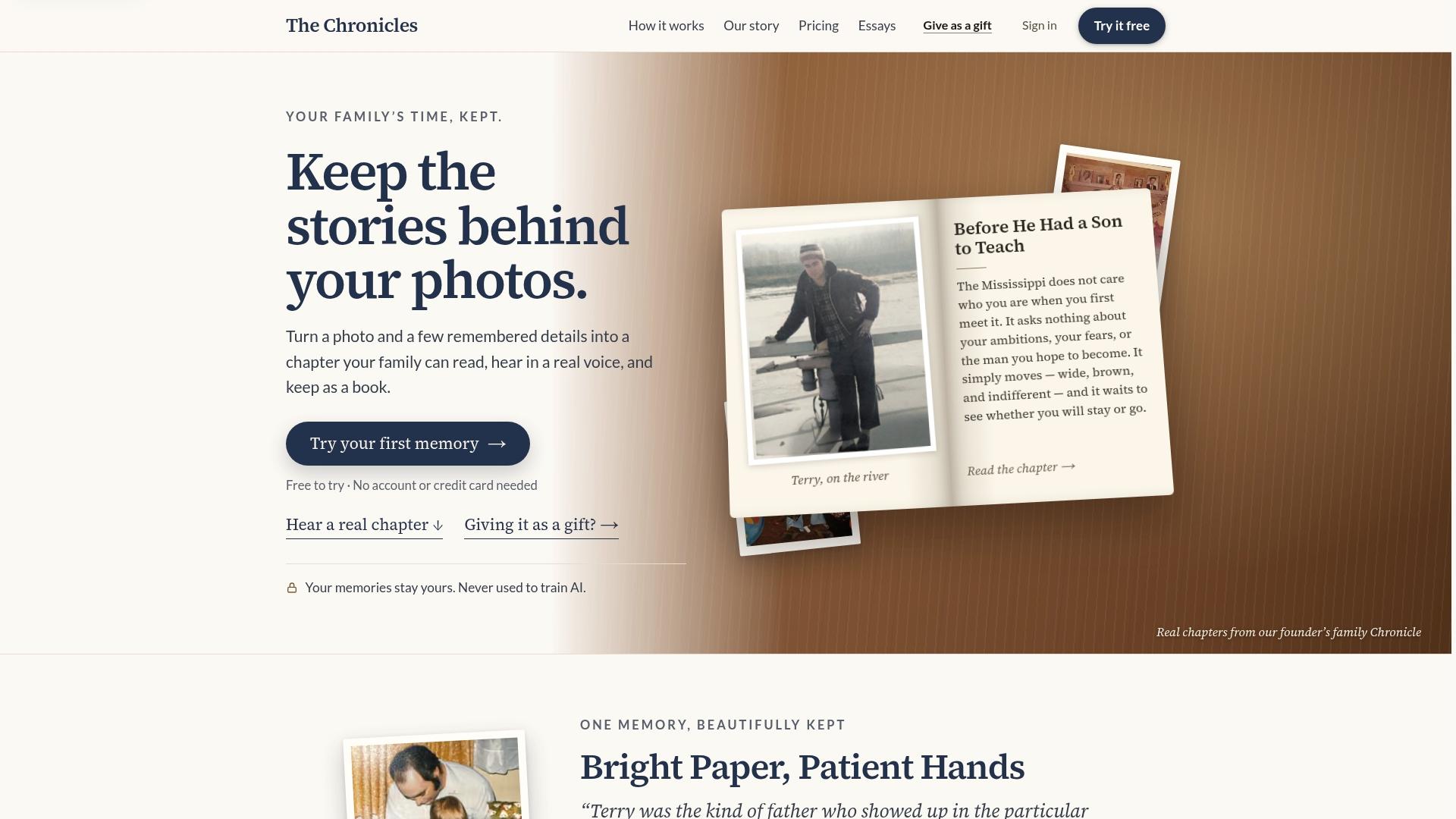
Printed books are ordered separately: Paperback from $49 and Hardback from $99. Start your family's book on The Chronicles or see the print book options. If you want a closer look at the approach, read how we create a family history book, or explore the photo story book idea if photographs are where you want to begin.
A Simple Plan for Your First Month
If you are not sure where to start, here is a gentle schedule.
Week 1: Choose and collect. Pick your scope. Gather twenty photos and any documents that relate to it. Scan them and name the files.
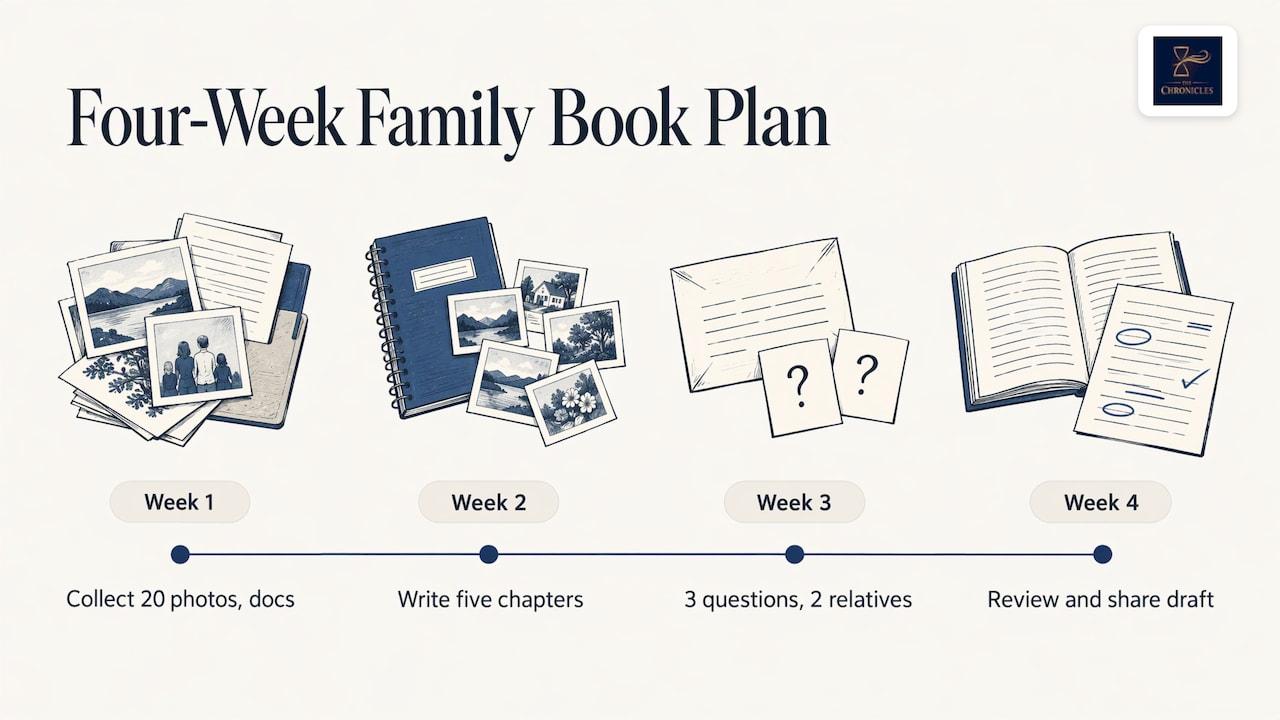
Week 2: Write the first five chapters. Choose five photos and write or dictate the story behind each. Do not aim for perfect. Aim for true.
Week 3: Ask for help. Send three questions to two relatives. Let them answer in whatever way suits them. Add what comes back.
Week 4: Review and share. Read the draft aloud, or listen to it narrated. Fix names and dates. Show it to the relatives who appear in it.
After that, you can keep adding a chapter a week, or order a first printed copy and begin the next volume. If a grandparent is the heart of your book, our page on grandparent stories shows how families approach it.
FAQ
What is the difference between a family heritage book and a family tree?
A family tree is a chart showing who is related to whom. A heritage book tells the stories behind the names: where people lived, what they cared about, and what they left behind. Many families include a simple tree inside the book for orientation.
How long should a family heritage book be?
There is no standard length. A focused book of 30 to 60 pages, built from short chapters and photographs, can be complete and deeply meaningful. Starting small and adding volumes later is usually more successful than aiming for one huge book.
Do I need genealogy research to make one?
No. Research helps if you want to go back many generations, but a heritage book can be built entirely from living memory, family photos and stories. If you do include research, cite where the facts came from and mark anything uncertain.
Can I make a heritage book if my parent can no longer tell their story?
Yes. Use photographs, letters, recipes and the memories of siblings, cousins and friends. Ask each person for one memory and weave them into chapters. Many families find the process comforting, and the finished book becomes a way to keep that person's voice present.
Can the whole family contribute?
Yes. On The Chronicles, relatives can add stories to a shared book, and less tech-savvy family members can respond to guided interview questions by email without creating a login. You decide what goes into the final book.
Sources
- Basics of Writing and Publishing Your Family History, American Ancestors
- Tips for Publishing Your Family History, Kentucky Genealogical Society
- Oral History Interview, Questions and Topics, JewishGen
- Digitizing Family Papers and Photographs, National Archives
- Personal Archiving Backpack manual, Buncombe County Special Collections
- 5 Steps to Digitizing Your Photos and Records, Family Tree Magazine
Recommended
From the founder
Start your first chapter — three minutes, no account.
Drop in a photograph of someone you love. Write three sentences about a moment with them. The Chronicles writes the chapter.
Try it free →Questions or thoughts? kevin@thechronicles.life — I read everything.