← Essays · November 17, 2026 · 14 min read
Family History Book Ideas: 12 Ways to Tell Your Story
Family history book ideas, formats and design tips for turning photos, letters and memories into a book your family will keep, with a simple plan to start today.
Family History Book Ideas: 12 Ways to Tell Your Story
The best family history book is the one that actually gets finished, and it usually starts smaller than you think: one person, one place, one tradition, one box of photos. Pick a single thread, pair each memory with a photo, and let the chapters add up. If you would rather not do it alone, The Chronicles turns your photos and short memories into written chapters you can hear, share and print.
TL;DR
- You do not need to write a book-length saga. Short stories paired with photos and documents make a family history book that people read.
- Choose a focus first: a person, a house, a recipe collection, a reunion, a hardship overcome, or a baby's first year.
- A simple structure works best: begin with an introduction, give each story a beginning, middle and end, and close with a short wrap-up.
- Gather memories by asking relatives for one story at a time, not for a whole life.
- Print it. A bound book on a shelf outlasts a folder of files.
Table of Contents
- Start with a focus, not a format
- Twelve family history book ideas
- What to put in the book
- Family history book format and structure
- Family history book design
- Templates you can make yourself
- How to gather memories from relatives
- Making it easier with The Chronicles
- A simple plan for your first weekend
- FAQ
- Sources
Start with a focus, not a format
Most family history projects stall for one reason: the scope is "everything." Everyone, every branch, every decade. That is a lifetime of research, not a book.
The American Ancestors guidance on turning research into a family history recommends keeping the project within scope and noting unresolved information rather than letting gaps stop the writing. That is permission worth taking. You can write "we never learned why Grandpa left Ohio" and keep going. The gap becomes part of the story.
Ask yourself three questions before you choose a layout:
- Who is this for? A new grandchild, a family reunion, a parent who is losing their memory, or a memorial for someone you miss.
- What is the thread? A person, a place, a food, a journey, a season of life.
- How will it be used? Read aloud at the table, given as a gift, or kept as a quiet heirloom.
The answers point you to the ideas below.
Twelve family history book ideas
Family Tree Magazine lists several project types that show how a family history can center on one person, place, event, tradition or group of objects: an ancestor biography, a memoir, a historical family album, a reunion book, an ancestral town or home history, a recipe collection, a scrapbook reproduction and an heirloom book. Here is how we would use those, and a few more, for real families.
1. A grandparent's life story
The classic, and the one most worth doing while the storyteller is here. Organize it by decade or by theme: childhood, work, falling in love, moving, raising children. Our guide to recording a grandparent's life story goes deeper on how to capture these in their own words.
2. A single ancestor biography
Pick the one relative everyone asks about. The American Ancestors handout notes that a biographical sketch can cover education, military and civic service, occupations, residences, religious affiliation and personal description, drawing on both records and family stories. That gives you a ready list of chapter prompts.
3. The hourglass book
The Kentucky Genealogical Society suggests an hourglass structure: start with one person in the middle, look up at their ancestors, then down at a couple of generations of descendants. It keeps the book focused while still showing where a family comes from and where it went.
4. A family recipe book with stories
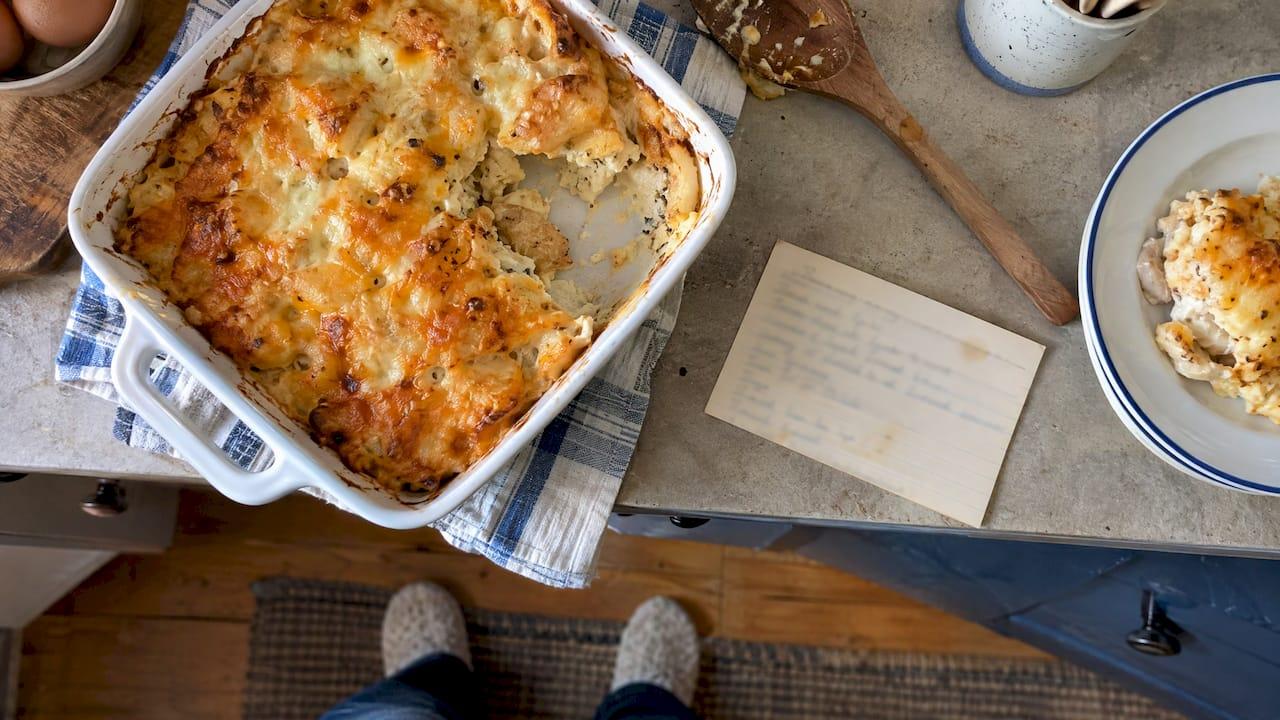
Every recipe has a person attached. Photograph the handwritten card, add the dish's story (who made it, for which holiday, what went wrong the first time), and you have a history that people will use in the kitchen.
5. A house or hometown history
Follow one address, farm or street through the decades. Old photos of the porch, the school or the main street, plus a few remembered scenes, tell a whole community's story.
6. A reunion book
Collect one short story and one photo from each branch before the gathering, and hand out the printed result. It gives a scattered family something shared to talk about.
7. A baby book of memories
For new parents, a family history can begin on day one: the story of the name, who the baby looks like, letters from grandparents, the first year in chapters. It grows into a book the child can read later.
8. A memorial memory book
For families who have lost someone, a memorial book gathers the stories that friends and relatives tell at the funeral and never write down. Take your time with this one. Short chapters, one memory each, are gentler than an attempt to summarize a whole life. Our memorial memory book page shows how this works with a single Chronicle.
9. A book for a parent in memory care
If a parent lives in a nursing home or memory unit, a book of familiar photos and short, warm stories can be something to look at and listen to together. Keep each chapter brief and anchored in a clear image: the old kitchen, the wedding, the dog. Hearing the story read aloud can matter as much as reading it.
10. A "photos first" scrapbook book
If you are a scrapbooker, start from the pictures. Give every photo a short caption and a story of a paragraph or two. See how to turn old family photos into a book and how a digital family scrapbook keeps the layout flexible.
11. A letters and documents book
Certificates, ticket stubs, postcards and letters carry voices that photographs cannot. Family Tree Magazine suggests pairing short narratives with photographs and documents such as certificates, recipes and letters, rather than assuming a story must be book-length.
12. A "family legacy" book that keeps growing
Instead of a finished volume, build a living collection that aunts, cousins and children add to over the years, and print a new edition when it feels right. This is the idea behind our family legacy book.
What to put in the book
The five ingredients the Kentucky Genealogical Society names for family photo books are photos, genealogical data, stories, documents and maps. You do not need all five in every chapter, but a good chapter usually has a photo, a story and one small piece of proof or detail.
For richness, add context. The American Ancestors handout recommends social, political, economic, geographic and cultural background to help readers see what shaped ancestors' lives. Family Tree Magazine likewise points to period items such as letters, newspaper clippings and hometown photographs. In practice that can be a single sentence: what the town looked like in 1952, what a day's wages bought, why so many neighbors left in the same year.
A few reliable chapter ingredients:
- A sensory detail: the smell of the kitchen, the sound of the screen door.
- A name, a place and a rough date, even if you are unsure. Mark uncertain dates as "about."
- One line in the person's own words, exactly as they said it.
- A caption on every photo naming who is in it. Future readers will not remember.
Family history book format and structure
Format questions are mostly questions of order. Three layouts cover nearly every family.
| Layout | Best for | How it reads |
|---|---|---|
| Chronological chapters | A single life story | Childhood to the present, one decade or era per chapter |
| Themed chapters | Memories that jump around | Work, home, food, faith, humor, hard times |
| Hourglass or branch-based | Several generations | One person in the center, ancestors above, descendants below |
Within each chapter, follow the American Ancestors advice: use a beginning, middle and end, organize around a clear point, and frame the whole book with an introduction and a conclusion. A chapter of 300 to 600 words with two or three photos is a comfortable size for most readers. This is our own rule of thumb, not a standard, so adjust it to your family.
Plain writing wins
The same handout recommends clear, consistent, plain-language writing and citing facts where you have them. Write the way the person talked. If Grandma called the couch "the davenport," keep it.
Family history book design
Good design is mostly restraint. A few choices matter more than all the rest.
- Readable type. The Kentucky Genealogical Society's author found that double columns and 12-point Times New Roman were easier to read and suited to placing photographs. Any clean serif at a similar size works.
- Endnotes over footnotes. If you cite sources, the same guide explains that endnotes keep the citations available without eating page space or interrupting the narrative.
- Generous photo size. One good large photo beats four small ones. Scan old prints at a high resolution before you start.
- Consistent captions. Same place, same style, every page.
- A short dedication or introduction. Say who the book is for and why you made it.
If you are using a template, Family Tree Magazine describes a simple photo-book workflow: upload images, choose a template, place and adjust photos, set backgrounds and layouts, add text, proofread and preview, then order. Proofreading and previewing the whole book before you order is the step people skip and regret.
Templates you can make yourself
You do not need a special template to begin. A one-page chapter outline works for every idea above:
- Title: the person, place or moment.
- Opening image: the photo that starts the story.
- The scene: where and when, in two or three sentences.
- The story: what happened, in the order it happened.
- The detail: a quote, a smell, a sound, an object.
- Why it matters: what this moment says about who the family became.
Copy this outline once per photo and you have a book skeleton. Fill the easy ones first.
How to gather memories from relatives
This is the part that decides whether your book is thin or rich. Some tips that work with real families:
- Ask small. "Tell me about your first job" gets a story. "Tell me about your life" gets silence.
- Start with a photo. People who cannot answer a question will talk for ten minutes about a picture.
- Let people contribute in their own way. Some will write, some will talk, some will only answer an email.
- Save and back up everything the same day, with the name of the person who told it.
- Do not wait. If a story is still in someone's head, today is the day to ask.
For relatives who are not comfortable with apps or passwords, we built guided email interviews: a relative receives questions by email and answers in a reply, with no login. It lets a 90-year-old aunt contribute without learning anything new.
Making it easier with The Chronicles
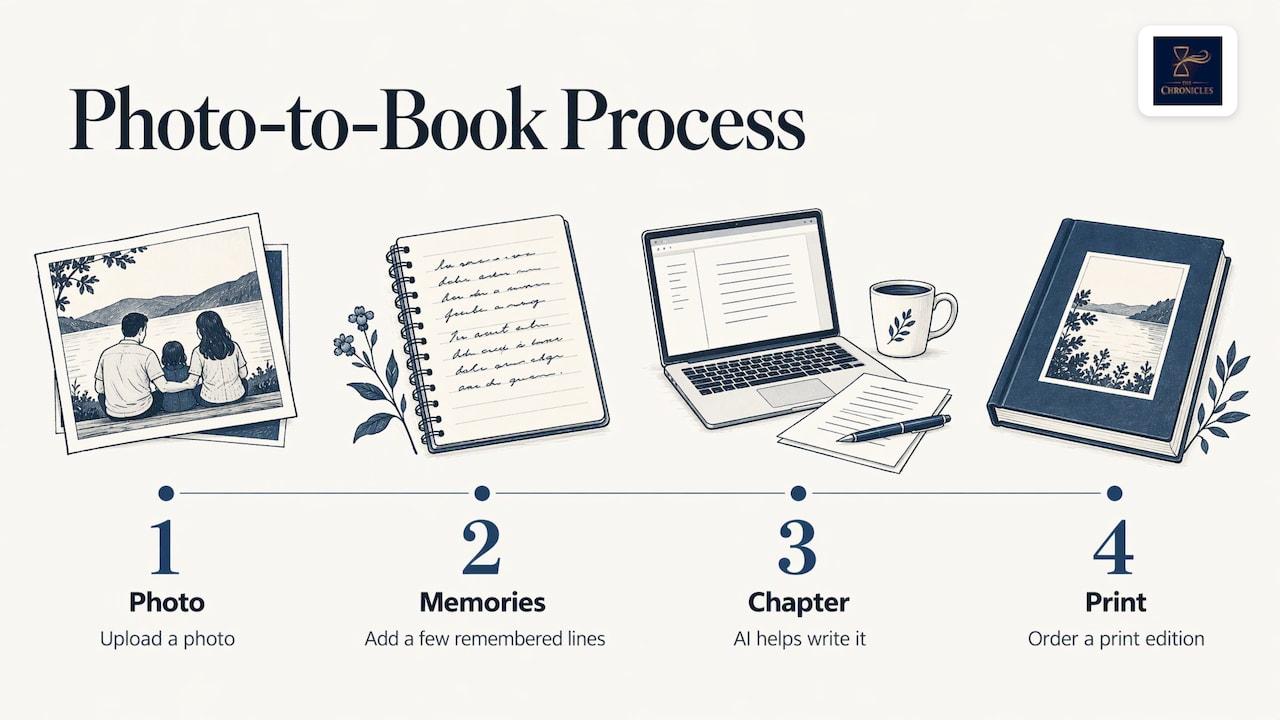
If the blank page is what is stopping you, start from your photos instead. On The Chronicles you upload a photo, add a few lines about what you remember, and AI helps turn it into a written chapter. Family members can add their own, and you can hear chapters read in real voices, including consented voice cloning for a loved one's voice. When the book feels ready, you can order a print edition.
Plans as published on our site: Free at $0, Chronicle at $7 per month, and Family at $15 per month. Printed books are bought separately: Paperback from $49 and Hardback from $99. You can see everything on our pricing page and browse the print books.
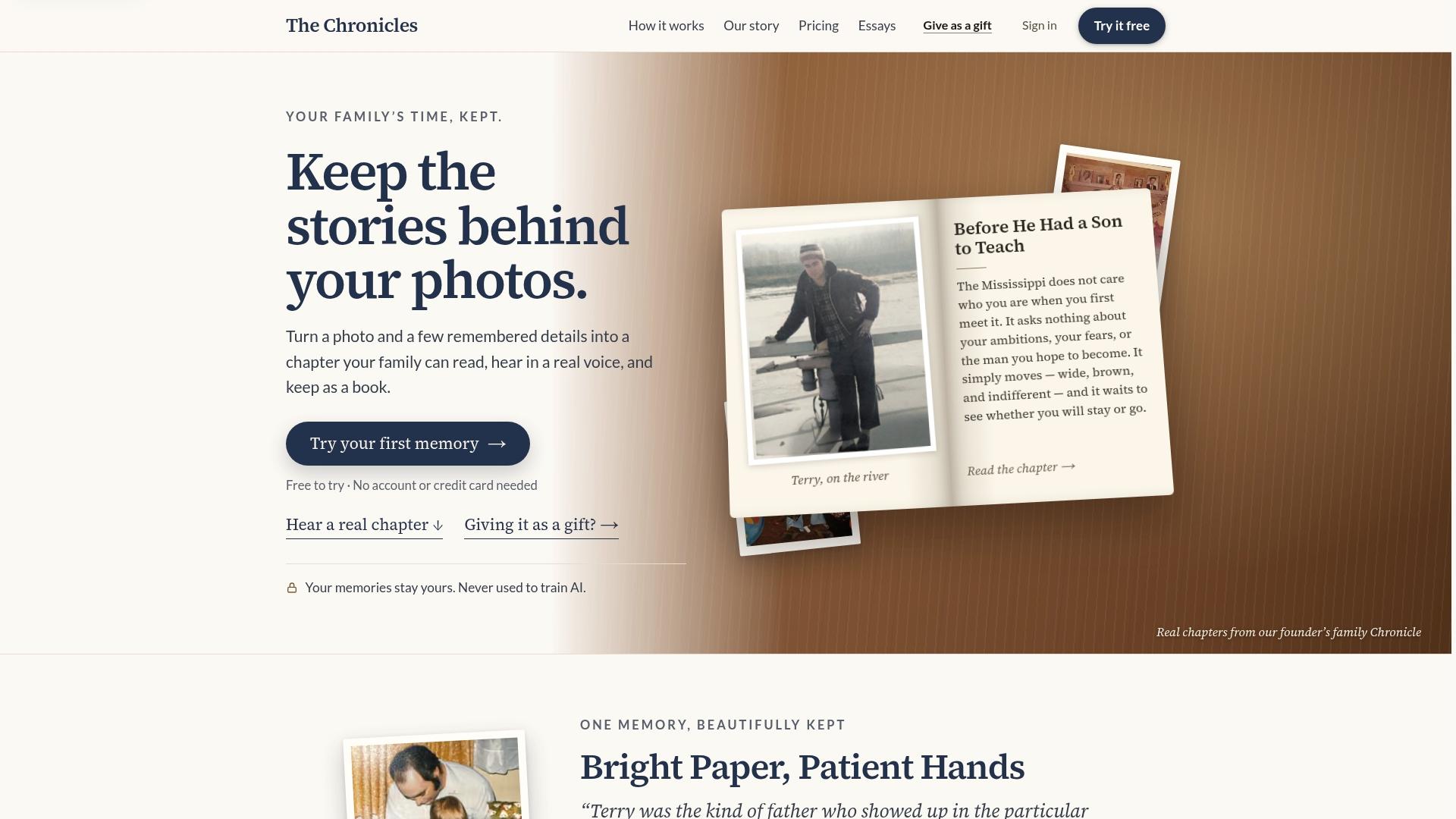
We never use your family's stories to train AI, you own your stories and can export them, and there are no ads. If you want to see how a Chronicle starts, begin with a free account and add your first photo.
For a deeper walk through photo-led storytelling, read our guide to a photo story book, or see how to write your life story from photos. When you are ready for the physical object, our piece on a printed family history book covers what makes one last.
A simple plan for your first weekend
You do not need a month. Try this:
- Saturday morning: choose one idea from the list and one person to center it on.
- Saturday afternoon: pick 10 to 15 photos and write a sentence about each.
- Sunday morning: ask two relatives one question each, by call or email.
- Sunday afternoon: write or generate the first three chapters, and read them aloud.
By Sunday night you will have a draft, and a draft is the hardest part to reach.
Why we think stories beat records
Families rarely lose their history all at once. It slips away in small ways: a photo with no names on the back, a recipe nobody wrote down, a grandmother's voice that nobody recorded.
That is why we built The Chronicles around chapters rather than family trees. A name and a date tell you who someone was. A story tells you what it was like to sit across the table from them. We want every family to be able to keep both, without needing to be a writer or a tech expert.
We also believe a family's memories should stay in the family. Your stories are never used to train AI, you own them, and you can take them with you. A family book should feel safe to fill with the things you hold most dear.
Kevin
FAQ
What is a family history book called?
People use several names: family history book, family chronicle, family memoir, legacy book or heirloom book. The name matters less than the shape. It is a collection of stories, photos and records about a family, gathered into a book that others can read.
How long should a family history book be?
There is no standard length. Family Tree Magazine notes that a story need not be book-length, and a short collection of well-captioned chapters can be a complete book. A common approach is 10 to 30 short chapters, each with a few photos, but your own family decides.
What should I include if I know very little about my ancestors?
Start with what you do know: your own childhood, your parents' stories, family photos and recipes. The American Ancestors handout advises noting unresolved information rather than letting gaps stop the writing. Mark what is uncertain and keep going. You can add to the book later.
Can I make a family history book for someone who has passed away?
Yes. Many families build a memorial book from stories shared by friends and relatives, along with favorite photos. Go gently and take it a chapter at a time. A single memory per chapter is often easier than trying to summarize a life.
Can relatives who are not tech-savvy still contribute?
Yes. On The Chronicles, relatives can answer guided interview questions by email, with no login. You can then add their answers to the chapters.
Sources
- Story to Family History 2023 Handout, American Ancestors
- 3 Family History Book Ideas (and How to Create Them), Family Tree Magazine
- Tips for Publishing Your Family History, Kentucky Genealogical Society
Recommended
From the founder
Start your first chapter — three minutes, no account.
Drop in a photograph of someone you love. Write three sentences about a moment with them. The Chronicles writes the chapter.
Try it free →Questions or thoughts? kevin@thechronicles.life — I read everything.