← Essays · November 13, 2026 · 13 min read
Grandparents Life Story Book: How to Make One Together
How to create a grandparents life story book: what to include, questions to ask, how to record with ease, and how to turn it into a printed keepsake.
Grandparents Life Story Book: How to Make One Together
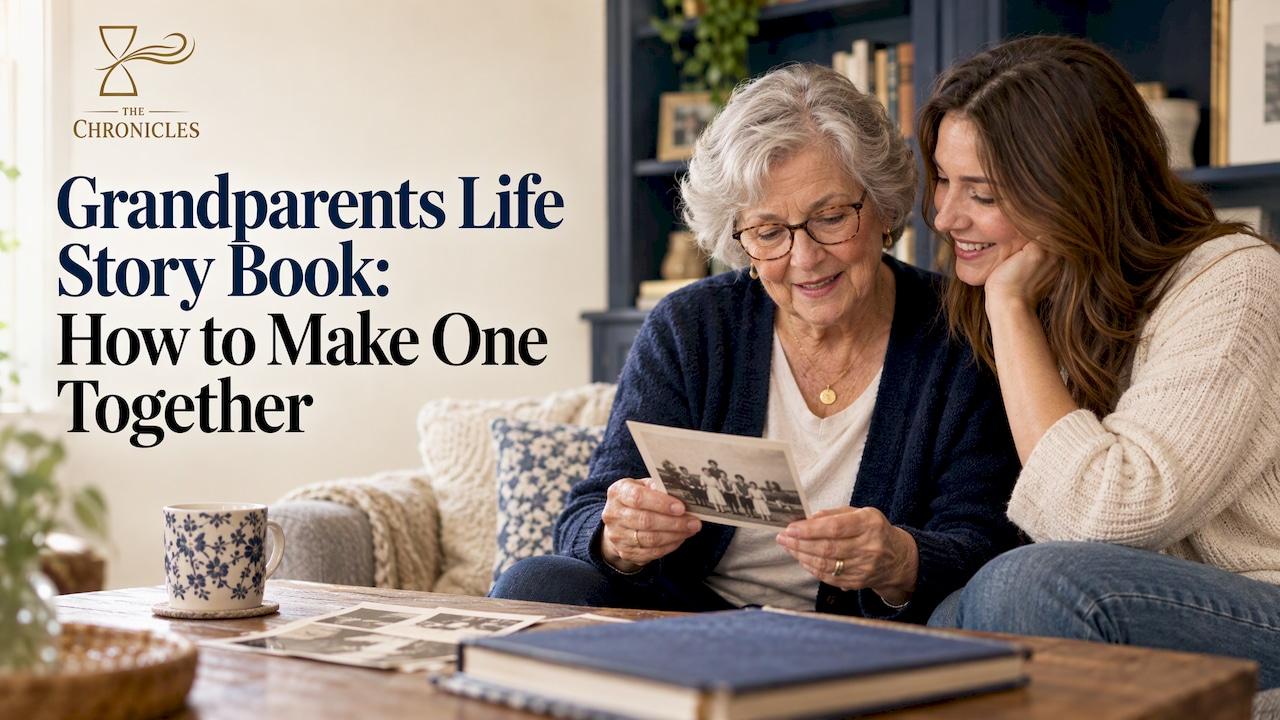
The best grandparents life story book is not a blank journal handed over with good intentions. It is a book built from your grandparent's own words, their photos and their voice, with you beside them. At The Chronicles, we turn photos and short memories into narrated chapters that your family can read, hear and eventually print as a book. Below you will find how to start, what to ask, how to make it comfortable for them, and how to end up with something you can hold.
TL;DR
- A life story book works best as a collection of small chapters, each built around one photo or one memory, not one giant writing project.
- Open-ended questions and a quiet, unhurried setting get better stories than a list of dates and facts.
- If your grandparent is not comfortable with technology, a guided email interview or a simple conversation you capture for them removes the barrier.
- Check privacy, ownership and export before you commit to any app or book service.
- The Chronicles has a free plan, paid plans at $7 or $15 per month, and print books from $49.
Table of Contents
- What a grandparents life story book actually holds
- Why chapters beat one big project
- How to help a grandparent feel comfortable sharing
- Questions that open up real stories
- Three ways to capture the stories
- Helping a grandparent who finds technology hard
- Capturing their voice, not just their words
- Special situations
- From stories to a book you can hold
- What to check before you choose any story service
- What it costs
- Start with one chapter
- Our point of view
- FAQ
- Sources
What a grandparents life story book actually holds
A life story book is a personal history told in your grandparent's voice. It is not a family tree, though it can sit beside one. A family tree tells you who was born when. A life story tells you why Grandpa left the farm, what Grandma's mother cooked on Sundays, and what it felt like to cross the country in a car with no air conditioning.
Most families find the book falls into a handful of natural themes:
- Childhood: the house, the neighborhood, school, friends, trouble they got into.
- Family: parents, siblings, grandparents they remember, how the family came to where it is now.
- Work and purpose: first jobs, the job they kept, what they were proud of.
- Love and friendship: how they met their partner, weddings, the friends who lasted.
- Turning points: moves, losses, hard years, the decisions they would make again.
- Wisdom: what they would tell a grandchild who is about to start out.
You do not need all of these. A book of twelve honest chapters is worth more than a hundred blank pages.
Why chapters beat one big project
The reason most life story projects stall is size. "Write your whole life" is a daunting instruction for anyone, and harder still at eighty-five. A chapter is small. It starts with a single photograph, a wedding portrait or a truck in a driveway, and one memory attached to it.
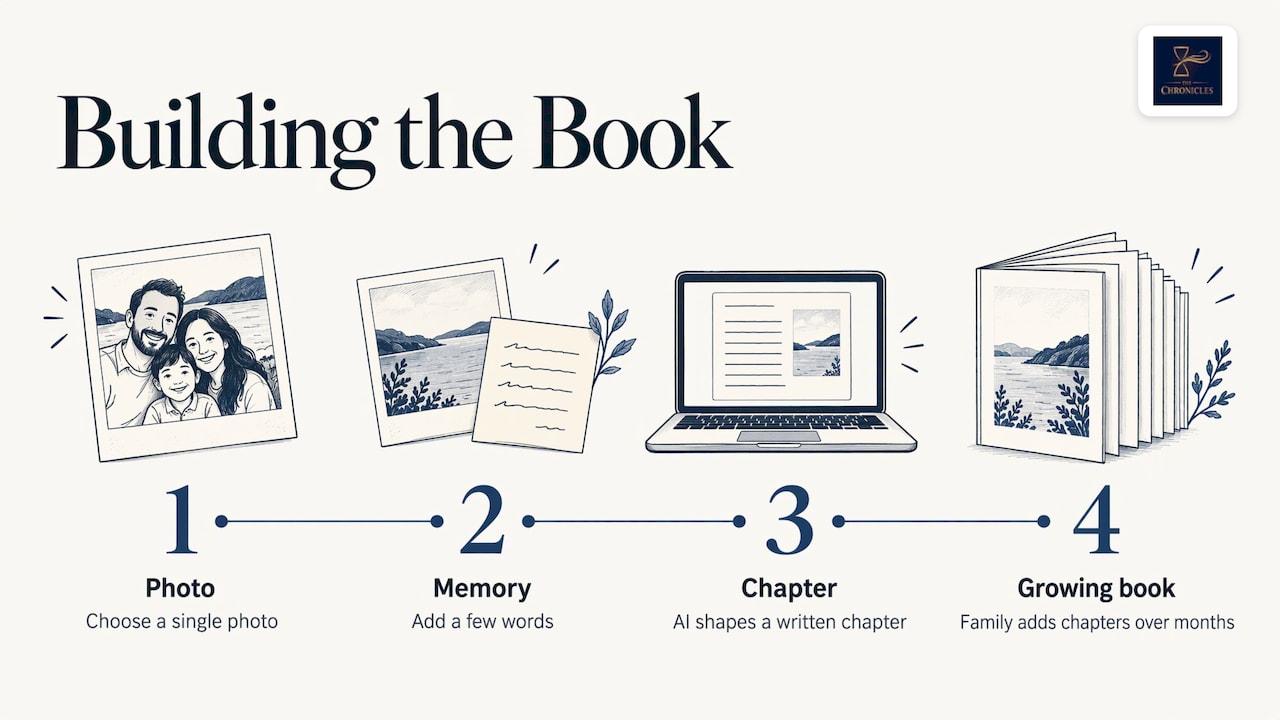
That is how The Chronicles is built. You add a photo and a few words about what was happening, and our AI helps turn it into a written chapter. Your grandparent can add chapters whenever a memory surfaces, and other family members can add their own. The book grows over months, not in one exhausting weekend.
How to help a grandparent feel comfortable sharing
Some grandparents talk freely the moment you ask. Others say, "Oh, nobody wants to hear about that." The second group often has the best stories. A few things help.
Start with objects and pictures, not questions
The Alzheimer's Association notes that photos, music, familiar objects and places can prompt older memories. Put a shoebox of photos on the table and let them pick up whatever catches their eye. Asking "Who is this?" is a test. Asking "What do you remember about that day?" is an invitation.
Aim for connection, not accuracy
The same guidance says reminiscence should focus on connection, not on testing memory. If Grandma tells the story of the flood with a different year than the one in the family notes, let it be. You can note the date later. What you are keeping is how she tells it.
Keep it short and unhurried
The Library of Congress Veterans History Project publishes best practices for oral history interviews. Its advice is simple and works for any family: pick a quiet indoor spot, talk with the person beforehand, ask whether there are topics they want included or left out, and pause before moving to the next question. Silence often brings the best part of the story.
A session of twenty to thirty minutes is plenty. Stop while they are still enjoying it.
Let them choose what stays private
Some memories are not for the book, and that is their right. Tell them up front that they decide what goes in, what is held back, and who sees it. People share more when they know they are in charge.
Questions that open up real stories
The best prompts ask for a scene, not a summary. Try these, and let the follow-up be "What happened next?"
Childhood
- What did your street look like when you were ten?
- What was dinner like at your house? Who sat where?
- What was your favorite place to hide?
Family
- What do you remember about your grandparents' kitchen?
- Who in the family could make everyone laugh?
- What did your parents argue about, and what did they never argue about?
Work and purpose
- What was your very first paycheck for?
- What did you love about your work? What did you not?
- Who taught you the most about doing a job well?
Love and friendship
- How did you meet? What did you think of them at first?
- What was your wedding day like, really?
- Who was your best friend growing up, and where did that friendship go?
Life lessons
- What is something you were certain about at thirty that you see differently now?
- What would you want your great-grandchildren to know about you?
Do not read the list like a form. Pick two or three, begin with a photo, and follow where the story goes.
Three ways to capture the stories
Families usually choose between writing in a guided journal, recording interviews, or using an app. They work differently, so it helps to see what each asks of your grandparent.
| The Chronicles | Recorded interviews | Guided memoir journal | |
|---|---|---|---|
| What your grandparent does | Shares a photo and a memory, answers an emailed question, or tells it aloud | Talks with you while you record | Writes by hand, page by page |
| What you get | Written chapters, narration in a real voice, a printable book | Audio or video files | One handwritten book |
| Works for hard-to-reach relatives | Yes, guided email interviews need no login | Needs you in the room or on a call | Needs good handwriting and stamina |
| Others can contribute | Yes, family members add chapters | Only if you share the files | One copy, one person |
| Turns into a printed book | Yes, paperback or hardback | Needs separate transcription | Already a book, but only one copy |
The Chronicles is built for the situation most families are really in: a grandparent with wonderful stories, a family spread across several states, and nobody with spare hours to transcribe tapes. You collect the stories in the way that suits each person, and the chapters come together in one place.
Helping a grandparent who finds technology hard
Many grandparents will not install an app or remember a password, and they should not have to. The Chronicles supports guided email interviews, so a relative can answer a question by replying to an email, with no login. You send the prompt, they reply in their own words, and the reply becomes material for a chapter.
This is also a gentle way to help a parent who tires easily, or who lives far from you. They can answer one question at a time, whenever they feel like it.
Capturing their voice, not just their words
The sound of a grandparent telling a story is something print cannot hold. The accent, the pause before the punchline, the way they say a grandchild's name. The Chronicles offers narration in real voices, so your family can hear chapters aloud. We also offer voice cloning, but only with consent, so a grandparent chooses whether their voice is used to narrate their own chapters. Our voice memory book page explains how chapters are heard aloud.
Special situations
A parent in a nursing home or memory unit
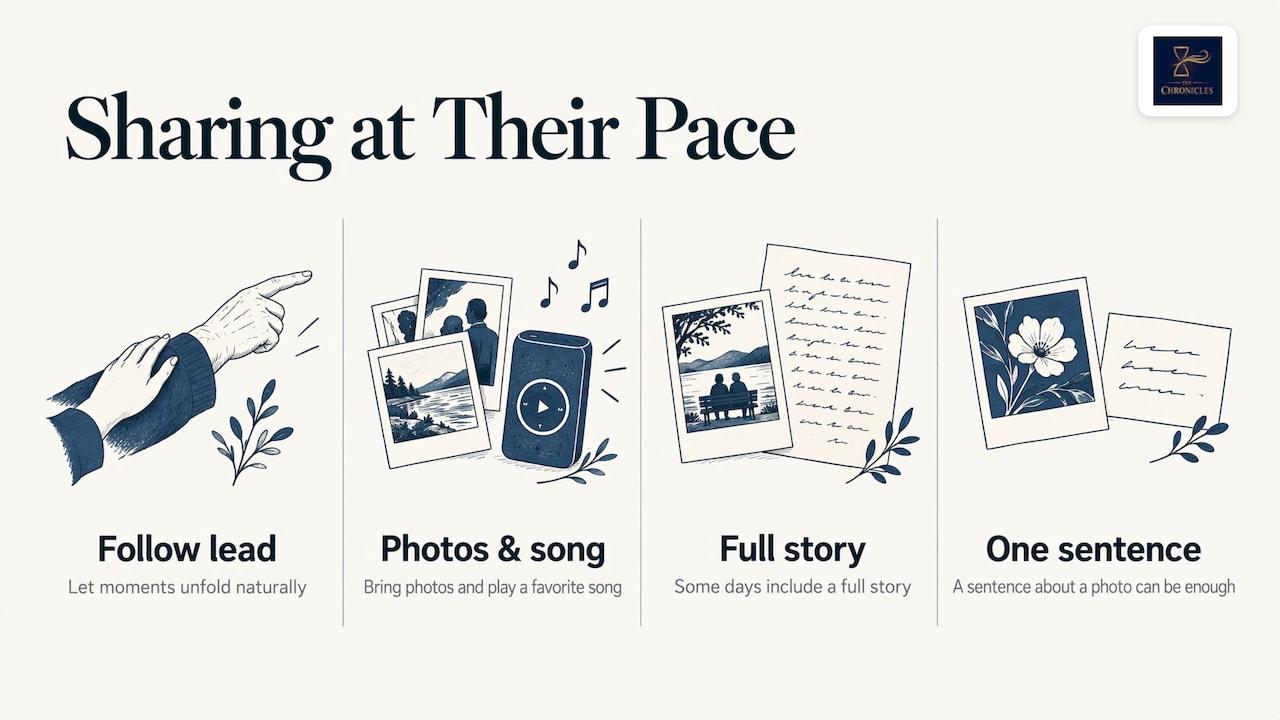
If your parent or grandparent lives in a nursing home or memory unit, the project changes shape, and it can be a good one. Follow the Alzheimer's Association's advice to follow the person's lead and let moments unfold naturally. Bring photos and play a favorite song. Some days they will tell a full story. Other days a single sentence about a photo is the chapter, and that is enough. If you are working through this, our guide on creating a parents life story book together walks through it.
When time is short
When a grandparent's health is declining, start with the stories you would most regret losing. Work from photos and a few spoken answers, not a full outline. Our page on grandparent stories before they are gone is written for this moment.
A memorial book after a loss
Families who have lost a grandparent or parent can build the book afterward from photos, letters and the memories relatives share. Every sibling and cousin can add their own chapter. A memorial memory book lets many voices make one story, and nobody has to carry it alone.
From stories to a book you can hold
Once you have ten or twenty chapters, you can have them printed. Here is a simple path.
- Pick the photos first. Choose the images that make the family stop and say "Look at that." One photo per memory is plenty.
- Collect the stories. Use a conversation, an emailed question or a spoken memory. Do not worry about polish.
- Let the chapters take shape. In The Chronicles, our AI helps turn photos and short memories into written chapters. You and your grandparent can read them and change anything that does not sound like them.
- Invite the family. Siblings, cousins and grandchildren can add their own chapters and photos, so the book shows how the family sees one person.
- Order the book. Choose a paperback or a hardback and order a copy for every household.
If you are planning the book as a gift for a grandparent who has just retired, you can pair it with ideas from these retirement gift registry ideas, and let the family contribute chapters instead of another item on the list.
For more on turning photos into a written history, see our page on writing your life story from photos, and our guide to the best ways to record a grandparent's life story.
What to check before you choose any story service
A family's stories are personal, so look closely at the terms before you upload anything.
- Privacy: Does the service say what happens to stories? Our pledge is that family stories are never used to train AI.
- Ownership and export: You should own what your family writes and be able to take it with you. With The Chronicles, you keep full ownership of your stories, with easy export.
- Lock-in and ads: We have no lock-in and no ads.
- Accessibility: Can a relative contribute without creating an account? Our guided email interviews need no login.
- Cost: Know the monthly price and the cost of printing before you start.
What it costs
The Chronicles has a free plan at $0. The Chronicle plan is $7 per month, and the Family plan is $15 per month. Plans cover unlimited chapters, AI assistance, narration and print book ordering. Printed books are paid for separately: paperback from $49 and hardback from $99. You can see every plan on our pricing page and the books on the book page.
Start with one chapter
You do not need to plan the whole book today. Pick one photo of your grandparent, ask one question, and write down what they say. The Chronicles has a free plan, so you can add your first chapter and hear how it reads before deciding anything more. Start your grandparent's first chapter.
Our point of view
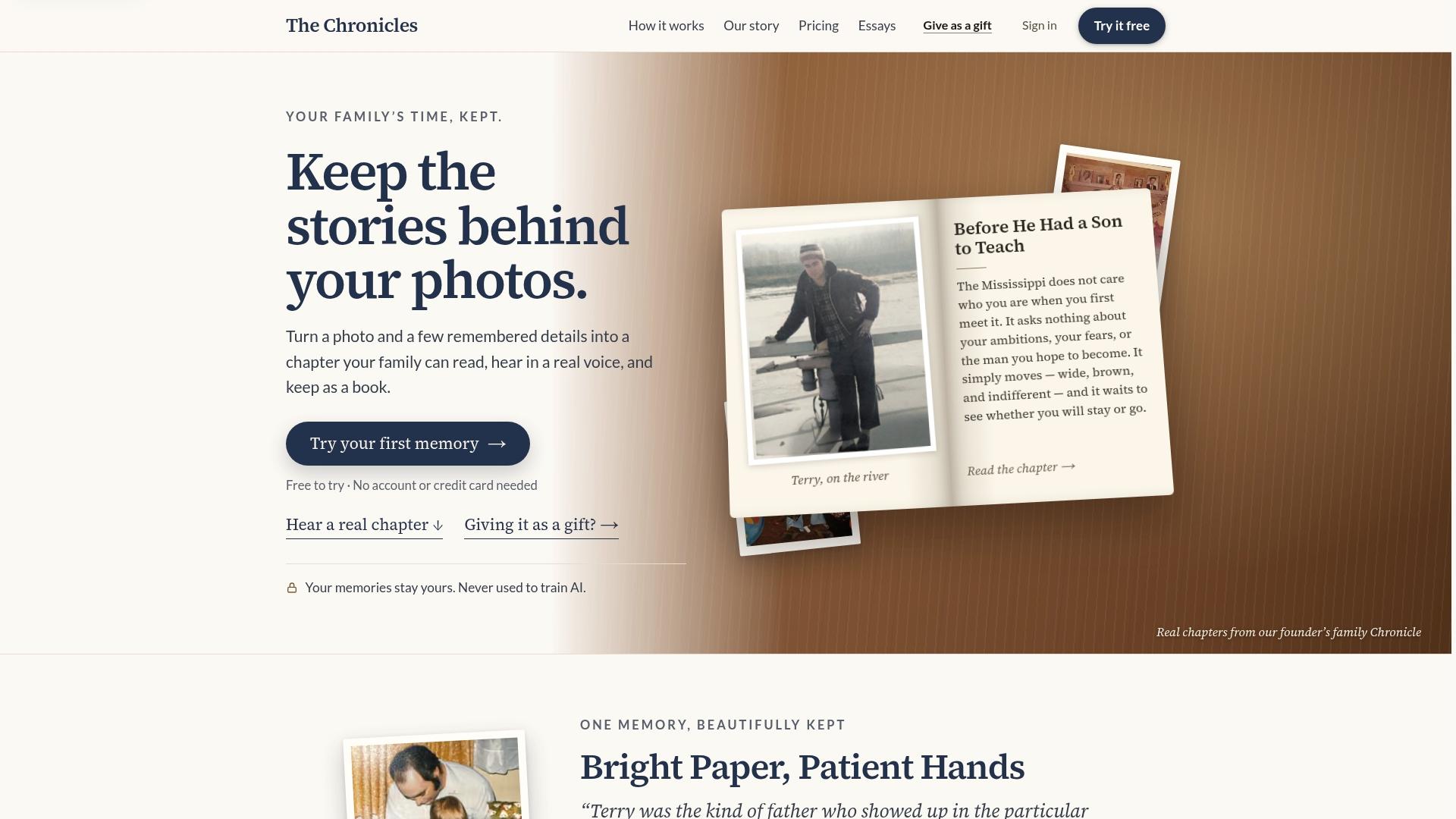
We built The Chronicles because the stories families most want are the ones that vanish first. They live in a grandparent's kitchen-table voice, and they rarely make it into a finished book.
What we have learned is that the barrier is almost never love. It is effort. A blank page is intimidating. A single photo and a gentle question is not. So we designed the whole experience around small steps: one picture, one memory, one chapter.
We also believe the stories belong to the family. That is why we promise never to use them to train AI, why you keep full ownership with easy export, and why we have no ads and no lock-in. Grandparents should be able to tell their stories without wondering where they end up.
If you take one thing from this guide, let it be this: begin while they can tell it themselves, and let the whole family help carry it.
Kevin
FAQ
What should a grandparents life story book include?
Include childhood, family, work, love and friendship, turning points and the lessons they want to pass on. Photos matter as much as words, because a picture often unlocks the memory. Twelve or so honest chapters make a full and satisfying book.
How do I get a grandparent to start talking?
Bring a few photos and ask what they remember about one day, not what the date was. The Alzheimer's Association advises that reminiscence should focus on connection rather than testing memory. Keep sessions short and pause often.
Can a grandparent contribute if they do not use technology?
Yes. With guided email interviews in The Chronicles, a relative can reply to an emailed question with no login. You can also record them in conversation and add their words as a chapter.
How much does it cost to turn stories into a printed book?
The Chronicles has a free plan, a Chronicle plan at $7 per month and a Family plan at $15 per month. Printed books are separate: paperback from $49 and hardback from $99.
Sources
- Reminiscence and Reminiscence Therapy, Alzheimer's Association
- Best Practices for Oral History Interviews, Library of Congress Veterans History Project
Recommended
From the founder
Start your first chapter — three minutes, no account.
Drop in a photograph of someone you love. Write three sentences about a moment with them. The Chronicles writes the chapter.
Try it free →Questions or thoughts? kevin@thechronicles.life — I read everything.