← Essays · November 3, 2026 · 14 min read
Newborn Keepsake Book: How to Make One You'll Treasure
What a newborn keepsake book is, what to put in it, which format fits your family, and a simple way to make one without falling behind.
Newborn Keepsake Book: How to Make One You'll Treasure
A newborn keepsake book is a place to keep the first days, the photos and the stories around them, in a form you can hold, read aloud and hand down. You can start it before the baby arrives or weeks later, and it does not need to be finished to be worth keeping. The simplest way to make one is to pick a format that fits your life, add a photo and a few sentences at a time, and invite the grandparents to add their own chapters.
TL;DR
- Start whenever you can: in the hospital, during the first week at home, or months in. A late start still makes a full book.
- Choose a format you will actually keep up with: a fill-in book, a scrapbook, or a story-based book built from photos and short memories.
- Write about the feeling of a season, not only dates and measurements. Milestones are a range, not a scorecard.
- Ten minutes every few weeks is enough, especially if grandparents and relatives contribute.
- Store the finished book and original photos flat, away from heat and damp.
Table of Contents
- What a newborn keepsake book really is
- When to start (and what to do if you're behind)
- What to include in a newborn keepsake book
- Prompts that get the words flowing
- Choosing a format
- A simple way to make your own
- Keeping it up when you have no time
- Perspective: why we think stories belong in the book
- Organize and preserve it for the long run
- Technology and your baby's own pace
- Turn your photos into a keepsake with The Chronicles
- Ideas for different families
- FAQ
- Sources
What a newborn keepsake book really is
Most people picture a padded cover with blank lines for birth weight, first smile and first tooth. That is one kind of keepsake book, and a lovely one. The idea is wider than that: any collection of photos, words and small details that tells the story of your baby's first weeks and months.
The pages that matter most years later are rarely the statistics. They are the room at 3 a.m., the song you kept humming, the way your father held the baby as if she might break. Those are the details that fade first, and the ones your child will ask about someday.
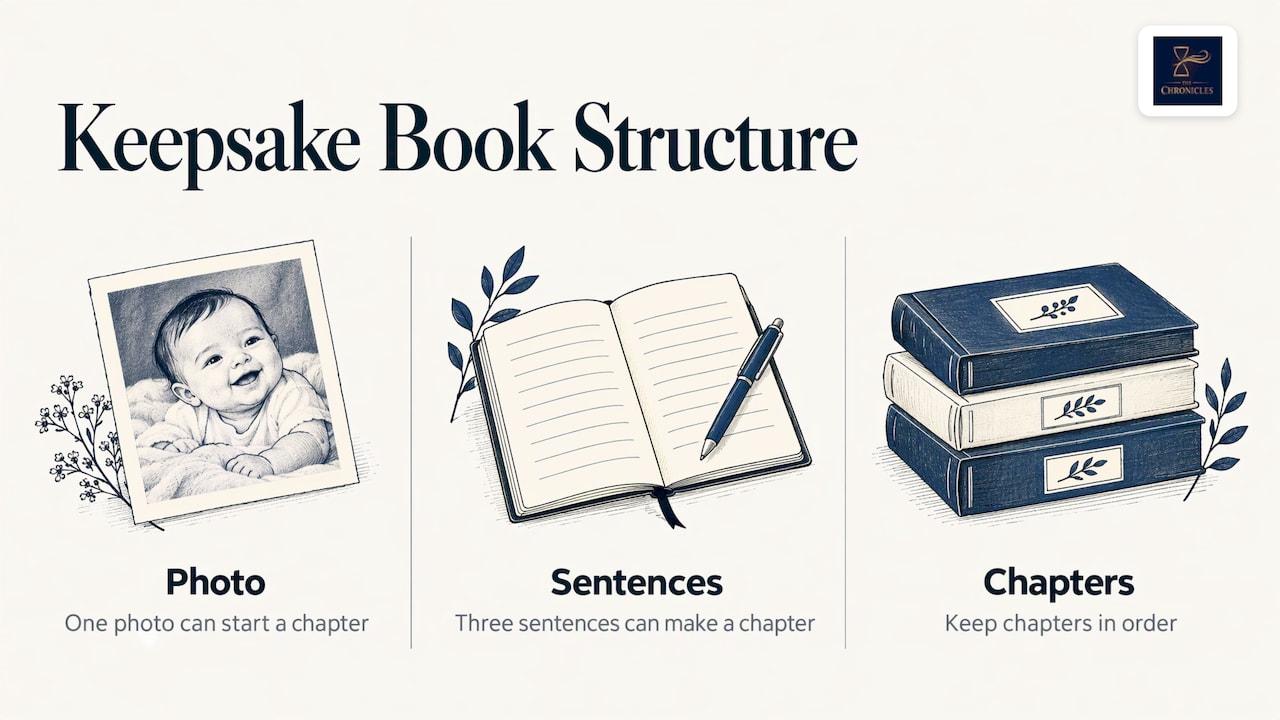
That is why we think of a keepsake book as a set of chapters rather than a form to complete. A chapter can be one photo and three sentences. A book is simply a good number of those, kept in order.
When to start (and what to do if you're behind)
There is no wrong moment. Some families begin with the pregnancy: the announcement, the nursery, the name list. Others begin with the birth day, when everything is vivid. Plenty begin at four months, in a rare quiet hour, scrolling through a camera roll that suddenly feels like a treasure chest.
If you are behind, you are in good company. Writing for Motherly, Abby Miller makes the point that milestones are a range, and that capturing the emotional arc of a season matters more than exact dates. You can fill in a missing month from memory, from photo timestamps and from what the people around you recall.
A practical way to catch up:
- Scroll your photos by month and pick one that sums up each month.
- Write what was happening around that picture: where you were, who was there, what you were worried about.
- Ask your partner or a grandparent what they remember. Their version will surprise you.
What to include in a newborn keepsake book
Think in layers. The facts anchor the book, and the stories give it life.
The facts that anchor it
- Full name and the story of how you chose it
- Birth date, time, place, weight and length
- Who was there, and who met the baby first
- The weather, the headlines, the song on the radio, if you remember
- A photo of the hospital bracelet, the going-home outfit, the car seat
These take minutes and become more interesting with every passing year.
The stories that bring it to life
- The first thing you noticed about your baby
- What the first week at home felt like
- The lullabies, the sleepless nights, the inside jokes
- Letters from you to your child, to be read at 18 or 30
- What each grandparent said the first time they held the baby
- Which family traditions your baby joined for the first time
The details you will not remember
Small, specific things go in the "I'll never forget this" pile and then vanish: the sound of the swing, the way the baby fell asleep only on one shoulder, the nickname you used for months. Jot them down while they are still true. Specifics are what turn a baby book into your baby's book.
Prompts that get the words flowing
Blank pages are the main reason baby books stall. Prompts fix that. A guide from Imaginisce suggests sentence starters such as "The first thing we noticed about you was..." and "Your first week at home felt like...", along with "We did not want to forget...". Finish any of them in two or three sentences and you have a chapter.
The same guide recommends asking relatives for their memories, with questions like what the grandparents said about this stage. Here are a few more to hand around the family:
- For grandparents: What do you remember about holding your own newborn? What do you hope for this baby?
- For siblings: What does the baby do that makes you laugh?
- For the other parent: What was the moment you realized you were a mom or dad?
- For you, at month three: What do you want to remember about being this tired and this happy?
Grandparents who are not comfortable with apps or long writing can answer by email, one question at a time, or simply tell the story out loud while someone writes it down. Our page on recording a grandparent's life story covers ways to do that gently.
Choosing a format
The best format is the one you will still be using in month seven. Here is how the common options compare.
| Format | Best for | What you do | Keep in mind |
|---|---|---|---|
| Fill-in baby book | Parents who like a ready-made structure | Write short entries and tuck in photos | Printed prompts set the pace, so choose a layout that matches the way you remember things |
| Scrapbook or memory journal | Crafty parents and scrapbookers | Print photos, add captions, ticker stubs and cards | Allow a little desk time and a place for supplies |
| Photo book from your phone | Photo-first families | Select pictures, add captions | Add more than captions so the stories are there too |
| Story-based book | Families who want narrated chapters and many voices | Pair each photo with a short memory and let the words be shaped into a chapter | Works best when relatives contribute along the way |
Many families combine two: a traditional book for the facts and ceremony of the first year, and a story-based book that grows alongside the child.
When you compare options, ask these questions:
- Will I really sit down with it, or will it be easier on my phone?
- Can others contribute without a learning curve?
- Can I add pages and chapters beyond the first year?
- Will I be able to print it, and what will it look like on a shelf in 20 years?
A simple way to make your own
Here is a plain process that works with a newborn's unpredictable hours.
- Decide the shape. One book for the first year, or an ongoing book that continues into toddlerhood? Deciding early prevents the "we ran out of pages" problem.
- Gather what you have. Hospital photos, ultrasound images, the card from the first visitor. Put them in one folder, physical or digital.
- Write one chapter at a time. Choose a photo, then answer one prompt. Do not edit. Rough and honest beats polished and never finished.
- Invite two or three people. Grandparents, an aunt, your best friend. Ask each for one memory about the baby.
- Set a rhythm. Every month, or every season, add a handful of new chapters.
- Print it when you are ready. A printed copy gives the book weight, and a version in the cloud means it is never lost.
Making it with The Chronicles
If you would rather not start from a blank page, our baby memory book approach is built on this process. You add a photo and a few words about it, and the platform's AI helps turn them into a written chapter in your own voice. Our photo to story app works the same way for any single picture. Relatives who dislike apps can contribute through guided email interviews, with no login. The book keeps growing, so it can follow your child well past the newborn weeks.
Keeping it up when you have no time
The fear of falling behind is common, and the fix is to lower the bar. Blogger Stevie Storck describes pulling out her baby journal every couple of months for five to ten minutes, keeping the journals displayed where she spends time because they are otherwise out of sight and out of mind, and setting aside ten minutes every few months for a couple of prompts.
Some habits that make it easier:
- Capture a seed. Type a sentence in your phone notes whenever something happens. Turn the seeds into chapters later.
- Pair a photo with a sentence right away. Photo plus sentence beats a perfect entry next month.
- Keep the book visible. A book on the coffee table gets used.
- Use nap time once a week. Ten minutes is a chapter.
- Let others do some of the writing. A grandparent's two paragraphs may be the best page in the book.
If your baby book is still blank at six months, nothing is lost. Choose your favorite photo from each month and write a short note about it. The book will still tell the story.
Perspective: why we think stories belong in the book
We built The Chronicles because the details of a family's life disappear faster than the photographs do. A picture shows what a day looked like. It does not tell your child who was in the kitchen, what was said, or why everyone was laughing.
A newborn keepsake book is the first chapter of that bigger story. We think it should be easy to start, easy to share, and easy to grow, so that a grandmother who never signs into anything can still add her memory with a simple email reply, and a new father can finish a chapter in two minutes at 2 a.m.
We also think it should stay private. Your family's stories are never used to train AI, and you own what you write, with simple export, no ads and no lock-in. Your baby's first chapters should belong to your baby's family and no one else.
If you can record the voices too, with real narration, you give your child something no printed page can: the sound of the people who loved them first.
Kevin
Organize and preserve it for the long run
The best-kept book will outlast the baby's own memory of childhood, so give it a little care.
The Conservation Center for Art & Historic Artifacts advises that photographs be stored flat in archival acid-free boxes or in albums with non-adhesive polyester sleeves, in an interior closet in your house rather than the attic or basement. The same guidance notes that keeping an album's order helps prevent the loss of information about what the pieces are, so keep your chapters in sequence and caption every photo with a name and date.
A few ways to apply that:
- Label the back of original prints lightly, or write names and dates on the page next to them.
- Keep digital originals in two places, such as a cloud account and an external drive.
- Keep hospital bracelets, cards and small mementos in an archival box beside the book, not pressed into it.
- Order a printed copy once a year or at the first birthday so that there is always a physical edition.
Technology and your baby's own pace
Phone apps and AI tools make it far easier to record the first year, and they should serve the story, not the chart. Whatever you use, remember that every baby moves through development at their own pace. If you like seeing a general overview of what to expect at each age, a child development calendar can give you context, while your book records your baby's own timeline in your own words.
Turn your photos into a keepsake with The Chronicles
If you want a newborn keepsake book that writes itself from your photos and grows with your family, start with The Chronicles. You can begin on the Free plan at $0, then move to Chronicle at $7 per month or Family at $15 per month when you want more room for everyone to contribute.
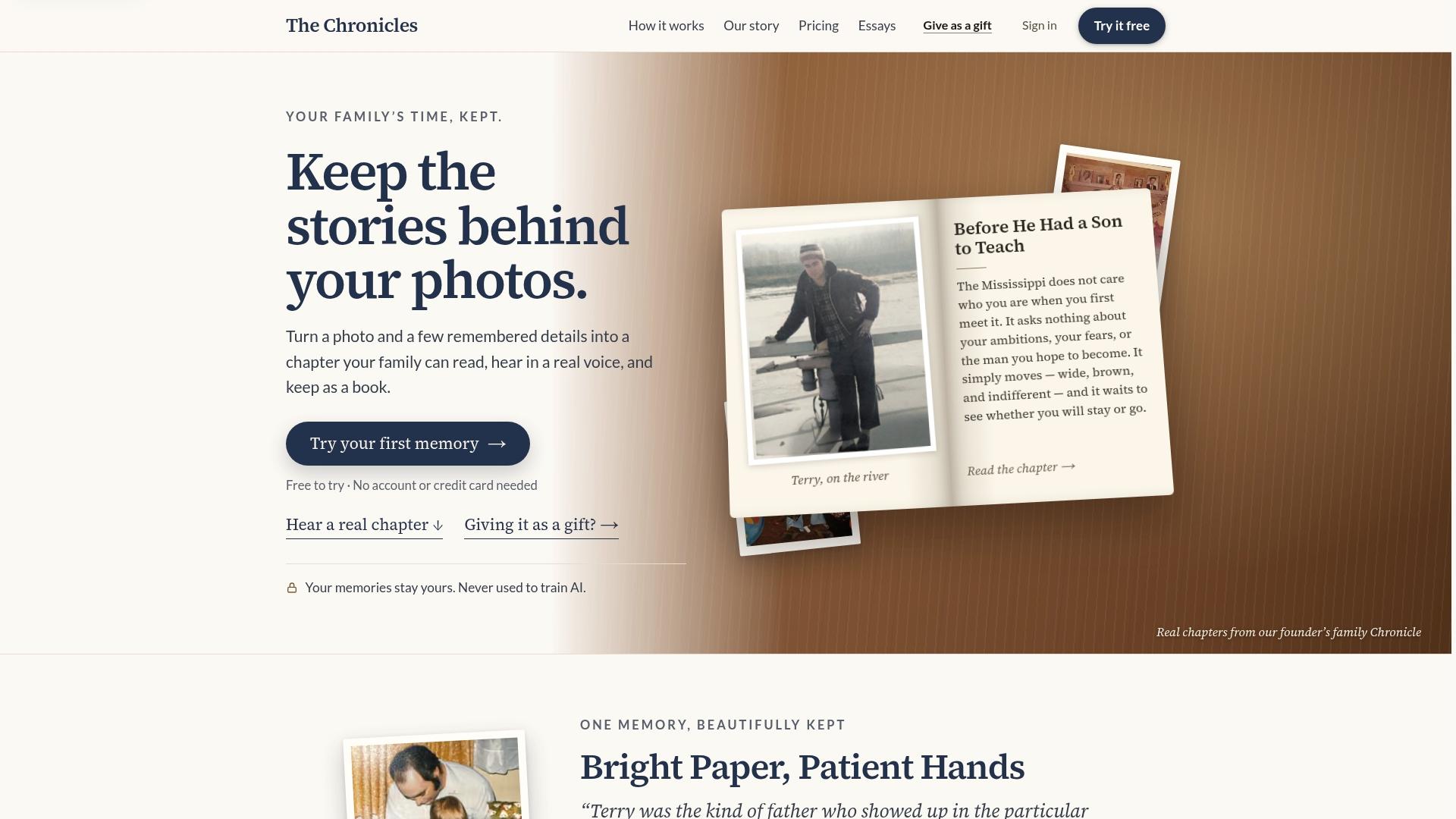
When you are ready to hold it, order a printed copy: Paperback starts at $49 and Hardback at $99, both one-off prices. See plans and start your first chapter or explore the print books.
Ideas for different families
New parents on a tight schedule. Take one photo a week and write two sentences. Ask your partner to do the same on alternate weeks.
Grandparents who want to give a gift. Offer to start the book with your own chapter: the day you found out, the first time you held the baby, a letter for your grandchild. Our page for grandparent stories shows how that works.
Families who want sound as well as words. Narration lets a baby one day hear the voices of the people in the book. Our voice memory book offers real voice narration and, with consent, voice cloning.
Families who have old photos to add. A baby book often becomes a family history project. If you want to include parents' and grandparents' childhood photos, our guide to turning old family photos into a book is a good next step.
FAQ
What should I write in a newborn keepsake book?
Start with the facts: name, birth details and who was there. Then add stories: your first impressions, what the first week felt like, and what relatives said when they met the baby. Specific details beat general statements, so write down the lullaby, the nickname, the smell of the nursery.
Can I start a baby keepsake book after the first few months?
Yes. Pick one photo from each month so far and write a short note about it, using timestamps and relatives' memories to fill in gaps. A book that begins late still tells a complete story.
How do I make a baby keepsake book if I'm not crafty?
Choose a format that asks for words and photos, not decoration. A fill-in book, a phone-based photo book or a story-based platform like ours lets you add a photo and a few sentences without any design work.
How can grandparents contribute?
Ask them a single question at a time, by email, over the phone or in person, such as what they remember about holding their own newborn. Their answers can be added as chapters under their own names, so the book carries many voices.
How should I store the finished book?
Keep it flat or upright in a cool, dry interior closet or shelf, not an attic or basement. Store loose photos in archival acid-free boxes or polyester sleeves, and keep digital copies in at least two places.
Sources
- You did not miss their childhood. You were living it (Motherly)
- Newborn Scrapbook Ideas (Imaginisce)
- How I'm Documenting the Story of Our Growing Family (Stevie Storck)
- Caring for Family Treasures (CCAHA)
Recommended
From the founder
Start your first chapter — three minutes, no account.
Drop in a photograph of someone you love. Write three sentences about a moment with them. The Chronicles writes the chapter.
Try it free →Questions or thoughts? kevin@thechronicles.life — I read everything.