← Essays · November 7, 2026 · 15 min read
Parents Life Story Book: How to Create One Together
How to make a life story book for your parents: gather stories and photos, ask better questions, handle memory loss gently, and protect the finished book.

Parents Life Story Book: How to Create One Together
The best life story book for your parents is one built from their own words, their own photos and a few good questions, asked one at a time. Pick a focus they care about, gather stories by phone, in person or by email, and turn them into chapters you can read, hear and print. You do not need to write a biography. You need to start while they can still tell it.
TL;DR
- Start small: one period, one theme or one set of photos. A full birth-to-today biography is the hardest format to finish.
- Ask specific questions ("Who was your best friend at twelve?") rather than broad ones ("Tell me about your childhood").
- Let photos and keepsakes open the conversation, and invite siblings and relatives to add their own memories.
- If your parent has memory loss, let them lead, go slowly and keep the format simple.
- Print a copy, keep a digital backup, and store originals away from light, heat and damp.
Table of Contents
- What a life story book for your parents really is
- Decide what the book is for
- Choose a shape that fits your family
- How to gather your parent's stories
- Make it manageable for a busy family
- When your parent has memory loss or lives in care
- Building a memorial book after a parent has died
- A quiet word from us
- Start your parent's book with The Chronicles
- Protect and share the finished book
- FAQ
- Sources
What a life story book for your parents really is
It is a book of memories in your parent's voice: the house they grew up in, how they met, the job they held, the recipe nobody else can quite make. It can run from birth to now, or it can follow a single thread, such as the years on the farm or the move across the country.
AARP describes this kind of project as making a book of a parent's life story and memories, built from interview questions focused on a chosen period and photos grouped by category. That is a useful frame. A life story book is not a form to fill in. It is a collection of chapters, each one anchored to a memory.
Three things usually go into it:
- Stories. Spoken or written, short or long.
- Photos and keepsakes. Pictures, letters, recipe cards, medals, ticket stubs.
- Voices from around them. Children, grandchildren, old friends and siblings who remember it differently.
Decide what the book is for
Before anyone asks a single question, agree on the purpose. AARP suggests naming it up front: preserving stories, giving your parent a creative outlet, reliving happy memories, or strengthening relationships. The answer changes how you work.
If the goal is a gift for a milestone birthday, you might aim for a polished printed book. If the goal is time together, the conversations matter more than the finished pages. If your parent is slowing down, the goal may simply be hearing them while you can.
Ask your parent directly. Some people light up at the idea. Others worry that nobody wants to hear about their life. Tell them the book is for the grandchildren, and that the details they think are ordinary are the ones the family will treasure.
Choose a shape that fits your family
AARP advises focusing on what the parent most wants to write about, because a full biography from birth to the present is the hardest format to tackle. Photo Memory Hub lays out three practical layouts:
| Shape | Best when | How it reads |
|---|---|---|
| Chronological | You want the whole arc and the story is intuitive to follow | Childhood, young adulthood, family, work, later life |
| Thematic | One interest or value defines your parent | Chapters on faith, the garden, the shop, the road trips |
| Milestone | You have few photos or want a shorter project | A handful of defining moments |
The chronological, thematic and milestone formats each work. If you are unsure, begin with a milestone book of five or six chapters. You can always add more later, and a short book that exists beats a grand one that never gets started.
How to gather your parent's stories
There is no single right method. AARP notes that stories can be gathered through in-person, phone or computer interviews, recorded on a phone or laptop or written by hand, and that family and friends can add anecdotes.
Pick the one your parent will actually enjoy:
- Sit-down conversations. One topic, one cup of coffee, a phone recording on the table.
- Phone or video calls. Ideal when you live far apart. Weekly twenty-minute calls add up to a book surprisingly fast. If you are weighing recording options, our guide to recording a grandparent's life story walks through them.
- Written answers. Some parents prefer to think quietly and reply in their own time.
- Guided email interviews. A question arrives in the inbox, your parent replies, and the answer goes straight into the book. No new app to learn.
Speaking of far-flung families, one small gift idea to sit alongside a finished book is a personalized engraved family tile, a keepsake for the kitchen shelf that carries the family name while the book carries the stories.
Ask specific questions
Broad prompts get short answers. AARP recommends asking about a best friend at a particular age or a concrete event instead of asking a parent to describe an entire stretch of life. Try these:
- What did your kitchen smell like on a Sunday when you were ten?
- Who was the first person you called with good news?
- What was your first paycheck, and what did you do with it?
- Which song takes you straight back to a particular night?
- What did you want to be before you became what you became?
Then follow the answer. "And what happened next?" is the most productive question in any interview.
Let photos do the prompting
Old photos and heirlooms are some of the best memory triggers. Photo Memory Hub suggests placing a few items in a quiet space and asking an open question such as "Tell me about the day you graduated," rather than asking someone to simply identify who is in the picture. A yes-or-no question ends the story. An open one starts it.
If you have a shoebox of prints, our guides on turning old family photos into a book and writing a life story from photos show how one picture and one memory can become one chapter.
Make it manageable for a busy family
Most families stall for the same reason: the project feels enormous. A few habits keep it moving.
- One topic per session. "The year we moved" is a session. "Your whole life" is not.
- Short and regular. Twenty minutes a week beats one exhausting weekend.
- Share the load. One sibling records, another scans photos, another writes captions.
- Do not wait for perfect. A rough chapter can be polished later. A forgotten story cannot.
- Let others add their view. A grandchild's memory of Grandma's kitchen belongs in the book too.
This is where a tool earns its keep. The Chronicles turns a photo and a few sentences of memory into a written chapter, so you are editing a draft rather than facing a blank page. You stay in charge of every word, and your parent's version of events always comes first.
When your parent has memory loss or lives in care
A life story book can be a real comfort when memory is fading, and it is also a gentle way to stay connected in a nursing home or memory unit. It needs a lighter touch.
Dementia UK's guidance is to let the person lead, take one topic at a time, work at their pace and take breaks. It also recommends clear text and simple layouts, and suggests considering what information the person wants shared with carers. That last point matters: ask your parent what they are comfortable having in the book, and who should see it.
Format is flexible too. The same leaflet says a life story can be a simple book, binder, collage, memory board, audio or video recording, memory box or personal profile, and that you can combine them according to the person's abilities and preferences. A printed book with large type, a voice recording of the family reading a chapter aloud, and a small box of touchstones can sit side by side.
A few practical notes from that spirit:
- Use photos of people and places from earlier decades. Long-ago memories often stay vivid.
- Keep the questions gentle and the mood unhurried. If a topic upsets your parent, move on.
- Do not correct. If a date is off, the feeling still belongs in the book. You can quietly check facts with siblings later.
- Share the finished book with care staff if your parent wishes. It helps them see the person behind the chart.
A review of life story resources in dementia care cautions that they call for sensitive and flexible communication, and that templates can either help structure the work or constrain creativity. In other words, use structure as a handrail, not a script. If your parent has a doctor or memory care team, ask them how to tailor the activity to your parent's stage.
For parents who cannot manage a screen, voice matters. A voice memory book lets chapters be heard aloud. The Chronicles supports real voice narration, including voice cloning only with consent, so the people who love your parent can hear a story in a familiar voice.
Building a memorial book after a parent has died
If your parent has already passed, the same project becomes a different kind of gift. The work shifts from interviewing to gathering.
One tribute-planning guide suggests collecting memories, photos, videos, memorabilia and writings from family and friends, then organizing the tribute and timeline, checking dates and facts, and choosing a presentation such as a family album. A memorial book can combine a chronological overview, personal reflections, photos, letters, recipes, awards and writings, along with memories from relatives and friends.
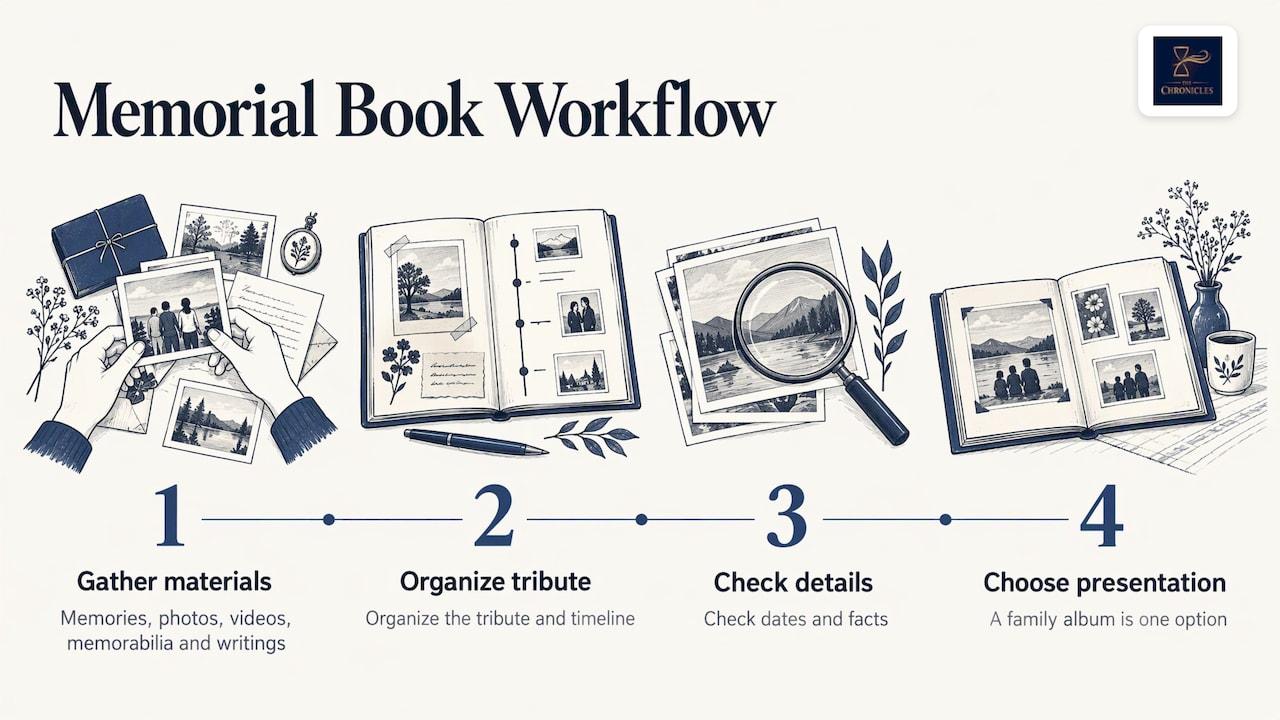
Go gently and go slowly. Grief does not keep a schedule, and nobody needs to finish in a month. Many families find it easier to start with something small, like a favorite recipe in Mom's handwriting and the story of who always asked for it. Invite cousins, neighbors and coworkers to send a memory. They often hold stories you have never heard.
Our memorial memory book page explains how one Chronicle can hold all of this, with many family members adding chapters over time.
A quiet word from us
We built The Chronicles because the stories behind a photo are the part families lose first. A picture shows who stood on the porch. It does not tell you why Dad was laughing.
That is why we focus on stories, not just albums. You bring a photo and a few sentences. We help turn them into a narrated chapter, and the family stays in charge of every word.
We also believe your family's stories belong to your family. Our pledge is that stories are never used to train AI, and you own what you write, with easy export. Parents should never have to wonder where their memories end up.
Not everyone in the family is comfortable with technology, and that is fine. Guided email interviews let a parent or grandparent answer questions without logging in, while the rest of the family collects the chapters into one place. Real voice narration lets a book be heard as well as read.
Start with one memory. The book will follow.
Kevin
Start your parent's book with The Chronicles
If you would rather not begin from a blank page, The Chronicles gives you a place to gather photos and short memories, shape them into chapters, add narration, and order a printed book when you are ready. You can start on the Free plan at $0, then move to the Chronicle plan at $7 per month or the Family plan at $15 per month when you want more room for the whole family to contribute.
When the chapters feel right, a printed book starts from $49 for a paperback or from $99 for a hardback, paid separately from the subscription. Start your parent's Chronicle or see the print books. If you want a wider family project, the family history book and family legacy book pages show how it can grow across generations.
Protect and share the finished book
A completed book deserves care. The National Archives recommends keeping family papers and photographs below 75 degrees Fahrenheit and below 65% relative humidity to prevent mold and reduce insect activity, while avoiding humidity under 15%, which can make materials brittle. NEDCC adds that family photographs and papers belong in the main part of the house rather than attics or basements, where temperature and humidity stay steadier.
For the original photos and letters you scanned for the book:
- Use boxes and folders that are lignin-free and acid-free or buffered, large enough to hold items flat or upright without bending, and not overstuffed.
- Keep originals out of the light. The Family Treasures Toolkit from the National Museum of African American History and Culture calls light Enemy Number 1 for sensitive materials, and notes that faded color photographs cannot be restored.
- Display or share copies, not originals. The National Archives says the best way to avoid damage is to display a copy and store originals in the dark.
- Skip laminated photo albums with acidic paper, harmful plastics and adhesives, as the same toolkit advises.
For the digital side, the National Archives suggests keeping scans on a computer hard drive rather than on discs, and asking other family members to hold backup copies. Photo Memory Hub makes the same point for books: keep high-resolution scans and the final PDF in at least two locations, and consider several print copies, since duplicates reduce the risk of losing the family history to fire or flood.
A simple way to do that: order one copy for each sibling, one for your parent, and keep the digital chapters in the family's shared Chronicle.
FAQ
How long does it take to make a life story book for a parent?
A short milestone book of five or six chapters can come together in a few weeks of weekly conversations. A fuller book takes months, and that is fine. Work in small sessions, and print when the chapters feel ready rather than when you have covered everything.
What if my parent says they have nothing interesting to share?
Most people feel this way. Start with a photo and one concrete question, such as who is standing next to them or what happened the day it was taken. Specific questions draw out stories that broad ones never reach, and your parent's ordinary days are exactly what grandchildren will want to read.
Can siblings and grandchildren contribute?
Yes, and the book is richer for it. AARP notes that family and friends can add their own anecdotes. In The Chronicles, relatives can add memories to the same family story, and guided email interviews let less tech-savvy relatives take part without a login.
Is a life story book still worth making if my parent has dementia?
Often it is, and it can be a meaningful way to spend time together. Keep sessions short, let your parent lead, and use simple layouts with clear text, as Dementia UK advises. Talk with your parent's care team about how to adapt the activity to their stage.
Who owns the stories, and are they used to train AI?
At The Chronicles, you own your family's stories and can export them. Our pledge is that your stories are never used to train AI.
Sources
- How to Help Older Loved Ones Write Their Life Story (AARP)
- The Legacy Book: Creating a Meaningful Life-Story Gift (Photo Memory Hub)
- Creating a life story for a person with dementia (Dementia UK)
- Life story resources in dementia care: a review (PMC)
- Honoring a Deceased Parent With an Online Tribute and Timeline
- How to Preserve Family Archives (National Archives)
- National Archives Fall Researcher News, 2016
- Family Treasures Toolkit (National Museum of African American History and Culture)
- Frequently Asked Preservation Questions (NEDCC)
- Personalised family name tile (MyTomette)
Recommended
From the founder
Start your first chapter — three minutes, no account.
Drop in a photograph of someone you love. Write three sentences about a moment with them. The Chronicles writes the chapter.
Try it free →Questions or thoughts? kevin@thechronicles.life — I read everything.