← Essays · November 10, 2026 · 17 min read
Questions to Ask Your Parents About Their Childhood
Over 70 thoughtful questions to ask your mom or dad about their childhood, plus how to start, follow up, handle hard memories, and keep every answer.
Questions to Ask Your Parents About Their Childhood
The best questions to ask your parents about their childhood are small and specific: "What did your bedroom look like?" works better than "Tell me about your childhood." Start with a place, an age or an object, ask "how" and "what" instead of yes-or-no questions, and listen for the story behind each answer. Below you will find more than 70 questions, grouped the way a real conversation unfolds, along with ways to ask about hard memories gently and to keep what you hear.
Whether you are sitting at your mom's kitchen table or phoning your dad on a Sunday night, you do not need to be a professional interviewer. You only need to be curious, and to start before the stories drift out of reach.
TL;DR
- Pick 5 to 10 questions per conversation, not all of them at once. Short, relaxed sessions get better stories.
- Begin with concrete things (the house, the street, a pet, a toy) and move toward feelings and family dynamics later.
- Use open questions that start with "how," "what" or "why," and follow up with "tell me more about that."
- For painful topics, give your parent the choice, go slowly and let silence and tears have room.
- Record or write down the answers right away, so they become a keepsake and not just a good talk.
Table of Contents
- How to ask so your parent actually opens up
- Where to start: home, house and earliest memories
- Everyday life: games, food, chores and holidays
- School and friendships
- The family you grew up in
- Questions to ask your dad
- Questions to ask your mom
- Asking about hard memories with care
- When a parent is older or has memory loss
- Questions to ask in the last stretch of the conversation
- We believe a parent's story is worth more than a list
- Keep the answers: from conversation to keepsake
- Turn their answers into a book your family can keep
- FAQ
- Sources
How to ask so your parent actually opens up
A list of questions only helps if the conversation feels like a conversation. A few habits make the difference.
Ask open questions. The Smithsonian's oral history interviewing guide recommends clear, concise, open-ended questions and says to avoid ones that can be answered with yes or no. It also notes that questions beginning with "How," "What" or "Why" draw fuller answers than those beginning with "Do" or "Did."
Treat the list as a guide. The Smithsonian Folklife team stresses that no single set of questions fits every family, and that the most useful questions are the ones you shape from what you already know about your own people. If you know your dad kept bees, ask about the bees.
Be patient. The Library of Congress Veterans History Project best practices tell interviewers to be good listeners, give the person time to reflect, pause before moving on, avoid interrupting, and avoid putting someone on the spot about exact dates and places. Nobody remembers the year their family got its first television. They do remember the show, the couch and who fought over the dial.
Keep one follow-up in your pocket. "Tell me more about that" is nearly always the right next question. So is "What was that like?"
Choose a comfortable setting. A drive, a walk, a pile of old photos or a card game often loosens memories better than a formal sit-down. If you record, set your phone nearby and look at your parent instead of the screen.
Where to start: home, house and earliest memories
Places and ages are easier doorways than feelings. Physical detail tends to pull other memories along with it. These make a gentle opening.
- What is your earliest memory?
- Where were you born, and what have you been told about that day?
- What did people call you as a child? Did you have a nickname?
- Were you named after anyone?
- What was the house or apartment like where you grew up?
- Describe your bedroom. Did you share it?
- Where did your family eat? Who sat where?
- What did the street or neighborhood look like, sound like and smell like?
- Where were you living when you were ten, and what was a normal day there?
- Which room in the house was your favorite, and why?
- Was there a spot you went to be alone?
- Did you have pets? How did they come into your life?
- What was the first thing you remember being afraid of?
- Who lived nearby: cousins, grandparents, neighbors who felt like family?
- What did you do on a typical summer day?
Everyday life: games, food, chores and holidays
Ordinary days are where families tend to find the best material. Ask about routine and the stories will arrive on their own.
- What games did you play, and who did you play them with?
- What was your favorite toy? What happened to it?
- Did you have songs, rhymes or sayings you used while playing?
- How did your family entertain itself in the evenings? Was there music or storytelling?
- What did a school-day morning look like at your house?
- What were the meals you loved, and the ones you dreaded?
- Who did the cooking? Is there a recipe you can still taste?
- What chores were yours? Did you get an allowance?
- How did you spend holidays? What was the one tradition you never missed?
- What was your birthday like as a kid?
- What was the family car, and where did you go in it?
- What did you want to be when you grew up?
- What was the first thing you ever bought with your own money?
- What was your first job, and what was the setting like?
- What did your family do on Sundays?
The Smithsonian's question bank covers childhood memories, games, toys and home entertainment such as songs and storytelling, which is why several of these echo it.
School and friendships
- What was your school like? How did you get there?
- Who was your best friend, and what did you do together?
- Who was your favorite teacher? Your least favorite?
- What subject did you love, and what subject made you want to hide?
- Did you ever get in trouble at school? What happened?
- What did you wear, and did you care?
- Who was the funniest person you knew back then?
- Was there a moment you felt proud of yourself?
- Did you ever move or switch schools? How did it feel to start over?
- What did you do after school?
- What was your first crush, and how did that go?
- If I could sit in your classroom for a day, what would I see?
The family you grew up in
Here you move from things to people. These tend to work best after your parent has warmed up.
- What were your own parents like?
- What was your role in your family growing up, and what were your siblings' roles? (Therapist Terry Real suggests this one to help you understand the dynamics that shaped a father, in a Seattle Times piece collecting expert questions for dads.)
- How did your parents show love? How did they show they were upset?
- What did your family argue about, and how did the arguments end?
- Who in the family made you laugh the most?
- What did your mom and dad do for work, and what did you understand about it at the time?
- What were the family stories that got told over and over?
- Was money tight or comfortable? How did you know?
- What did your grandparents mean to you?
- What did your parents hope you would become?
- Which family rules did you follow, and which did you quietly break?
- What did the family do when someone was sick or something went wrong?
Questions to ask your dad
Many people searching for questions to ask their dad find that fathers open up more sideways than head-on: side by side in a car, in the garage, over a game on TV. The same childhood questions apply, plus a few that lean into the way dads often see their own role. These come from the Seattle Times collection, credited to the people who suggested them:
- "When you were growing up, what was your idea of what a dad should be like?" (Bryce Dallas Howard)
- "When you were younger, who were your best friends and how did you spend your free time?" (Kier Gaines)
- "Describe the house or apartment you grew up in. Where did you eat? Where did you play?" (Elizabeth Keating)
- "What good things from your childhood did you hope to pass down to me, and what did you hope to spare me?" (Scott Galloway)
Add a few of your own: What did your dad teach you without meaning to? What was the first thing you fixed or built? When did you first feel grown up?
Questions to ask your mom
Moms often have a stronger memory for names, kitchens and small rituals, so lean into detail.
- What did your mother's kitchen smell like on a weekday?
- What did you wear for special occasions? Do you remember a favorite outfit?
- Who taught you to cook, sew or do whatever you are good at?
- What did you and your sisters or friends talk about?
- What did you dream of before you knew you would be my mom?
- What was the best day of your childhood?
- What did you do when you were scared or lonely?
- What do you wish you had asked your own mother?
Asking about hard memories with care
Not every childhood was happy, and some memories carry pain. You do not have to avoid them, but you do have to let your parent lead.
Ask what is okay. The Veterans History Project recommends a brief conversation beforehand to ask whether there are topics the person wants included or avoided. You can do the same: "Is there anything you would rather we skip?"
Time it kindly. In an NPR piece on capturing a parent's hidden story, writer Kao Kalia Yang explains that she waited decades before asking her mother about difficult experiences, and suggests lining up deeper questions with milestones in your own life, such as becoming a parent.
Let tears happen. NPR reports that when a parent becomes emotional, Yang advises resisting the urge to rush in with reassurance. Sit with the discomfort and honor the memory instead.
Some gentle ways in:
- What was the hardest year of your childhood?
- Was there a time you felt you had to grow up too fast?
- What do you wish someone had told you back then?
- Is there something from that time you have never really talked about?
- What got you through it?
If the answer is "I would rather not," accept it warmly and move on. You can always come back in a year. If a childhood involved trauma or abuse, a licensed therapist or counselor can help you and your parent decide how to handle those conversations.
When a parent is older or has memory loss
Long-ago memories can be a source of comfort and connection, but the way you ask matters. Guidance on communicating with a person who has dementia from Alzheimer's Society suggests avoiding efforts to jog their memory, which can feel frustrating and embarrassing. Instead, share things you remember yourself so they can join in at their own pace. It also advises against piling on open questions, and recommends photos or familiar objects as prompts.
In practice:
- Swap quizzes for invitations. Instead of "Do you remember your first school?" try "I love the photo of you in front of that brick school. It looks like a great place."
- Offer choices. "Did you walk to school or ride the bus?" is easier than "How did you get to school?"
- Use photos and objects. An old record, a recipe card or a worn baseball glove can spark more than any question.
- Keep sessions short. Ten gentle minutes beats an hour of effort.
- Accept the story as it comes. If details shift, the feeling in the telling is still worth keeping.
- Bring in other relatives. Siblings, cousins and old friends can fill in names and dates your parent no longer reaches for.
If you live far away, or your parent is in a nursing home or memory unit, ask a sibling or a caregiver to look through photos with them and note a line or two. Small captured moments add up.
Questions to ask in the last stretch of the conversation
When your parent is relaxed and talking, these reflective questions often bring the best answers:
- What is the happiest memory from your childhood?
- What do you miss most about those years?
- What would you want your grandchildren to know about where you came from?
- What did your childhood teach you that you still believe?
- What would you tell your ten-year-old self?
- What do you remember about me as a child that I might not know?
- How did growing up in your family shape the way you raised me?
The last two flip the questions around, and parents often love that part. You may learn something about your own childhood too.
We believe a parent's story is worth more than a list
Over the years, I have watched families collect wonderful answers and then lose them: a voice memo buried on a phone, a notebook in a drawer, a conversation remembered half-right a decade later. The questions are the easy part. Keeping the answers is where most of us struggle.
We built The Chronicles around a simple idea: the story behind a photo matters as much as the photo. When your mom tells you about the porch in that faded picture, that is a chapter. When your dad describes his first job, that is another. Put them together, and you have a family history in your own people's words.
We also believe that families should own what they create. Your stories are never used to train AI, and you can export them whenever you like. For relatives who are not comfortable with technology, our guided email interviews let them answer without needing a login. And when you are ready, you can hear the stories narrated aloud or hold them in a printed book.
Start with one question. Ask it this week.
Kevin
Keep the answers: from conversation to keepsake
A good conversation can disappear in a week. A few practical ways to keep it:
- Record it. Video is best if your parent is comfortable. The Family History Interview Kit suggests keeping files somewhere that will still open in fifty years. Audio alone is fine too. Prop your phone on a stack of books and sit beside it, so your parent talks to you, not the lens.
- Write notes the same day. Jot down the funny phrase, the name of the street, the thing that made your mom laugh.
- Transcribe the key parts. The Veterans History Project's transcription guide notes that all media deteriorates over time, which is why a written transcript matters for long-term preservation. It also advises keeping the speaker's own words and not rewriting them into formal prose, so the voice stays theirs.
- Match answers to photos. A picture plus a spoken story is far more meaningful than either alone.
- Turn it into chapters. Short pieces, one memory each, are easier to share than a long transcript.
If you would like more help with this part, our guides on recording a grandparent's life story, preserving family stories before they are gone and writing your family history step by step walk through each stage. If it is your grandparents you are interviewing, you will find 80+ questions for grandparents there too.
Turn their answers into a book your family can keep
The Chronicles takes the photos and short memories you collect and turns them into written chapters, with AI help that keeps the story in your family's voice. You can add real voice narration, invite relatives to contribute, and order a printed book when it feels ready.
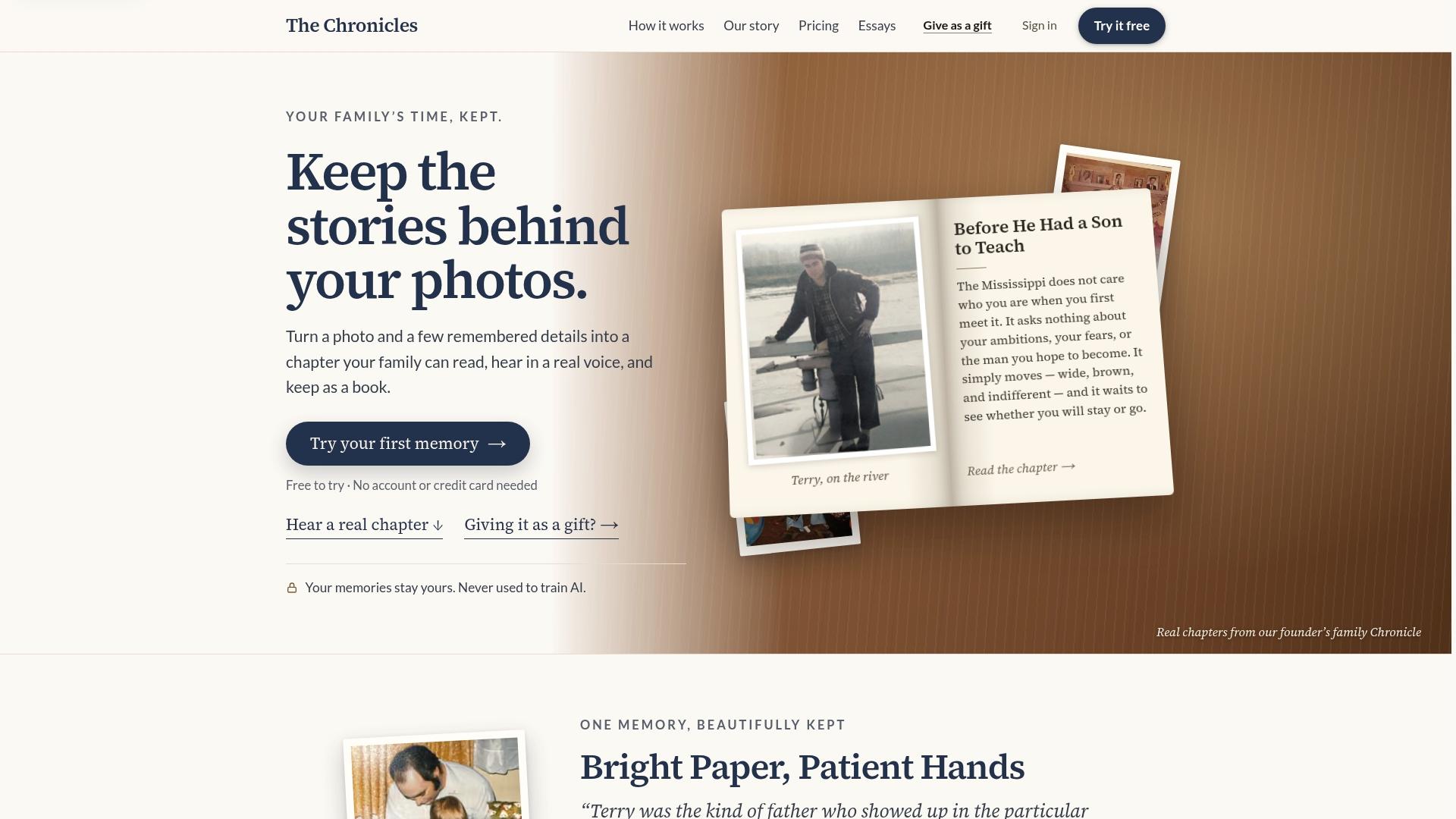
There is a Free plan at $0, a Chronicle plan at $7 per month and a Family plan at $15 per month, and you can start on the Chronicles home page. Printed books start at $49 for a Paperback and $99 for a Hardback, and you can see the options on the book page. If you want to see how the pieces fit together, read about our photo to story app or the voice memory book.
FAQ
How many questions should I ask in one conversation?
Pick five to ten. Childing.org suggests choosing a handful of questions at a time instead of asking dozens in one sitting, and that matches how real conversations work. Let one good answer lead into follow-ups, and save the rest of the list for another visit.
What if my parent says they do not remember much about their childhood?
Try a concrete prompt instead of a broad question: an old photo, a song from the era, a smell from the kitchen. Ask about one small thing, like a toy or a street, and share a memory of your own to start. Some people need a few conversations before the stories begin to flow.
Is it okay to ask about painful memories?
Yes, if your parent is willing and you let them set the pace. Ask beforehand whether there are subjects they would rather skip, and be comfortable with silence or tears. If the history involves serious trauma, a licensed therapist can help guide the conversation.
What is the best way to start if I have never asked before?
Start small, with something light: "What was your favorite thing to do as a kid?" or "What did your bedroom look like?" Do it during something else, such as cooking or a drive. After a few casual chats, deeper questions feel natural.
How do I keep my parent's answers safe?
Record the conversation, write a few notes the same day, and keep copies in more than one place. Then turn the best stories into chapters with photos so they are easy to read, hear and share with the rest of the family.
Sources
- Smithsonian Folklife and Oral History Interviewing Guide
- Smithsonian Center for Folklife and Cultural Heritage: Some Possible Questions
- Library of Congress Veterans History Project: Best Practices for Oral History Interviews
- The Seattle Times: Want to Know Your Dad Better? Try These Questions.
- NPR: How to capture a parent's hidden story
- Alzheimer's Society: How to communicate with a person with dementia
- Veterans History Project: Guide to Transcribing and Editing
Recommended
From the founder
Start your first chapter — three minutes, no account.
Drop in a photograph of someone you love. Write three sentences about a moment with them. The Chronicles writes the chapter.
Try it free →Questions or thoughts? kevin@thechronicles.life — I read everything.