← Essays · November 24, 2026 · 11 min read
How to Record Family Stories: A Simple Guide for Families
Learn how to record family stories, from a grandparent's life story to a parent's voice, with simple tools, good questions, safe backups and a finished keepsake.
How to Record Family Stories: A Simple Guide for Families
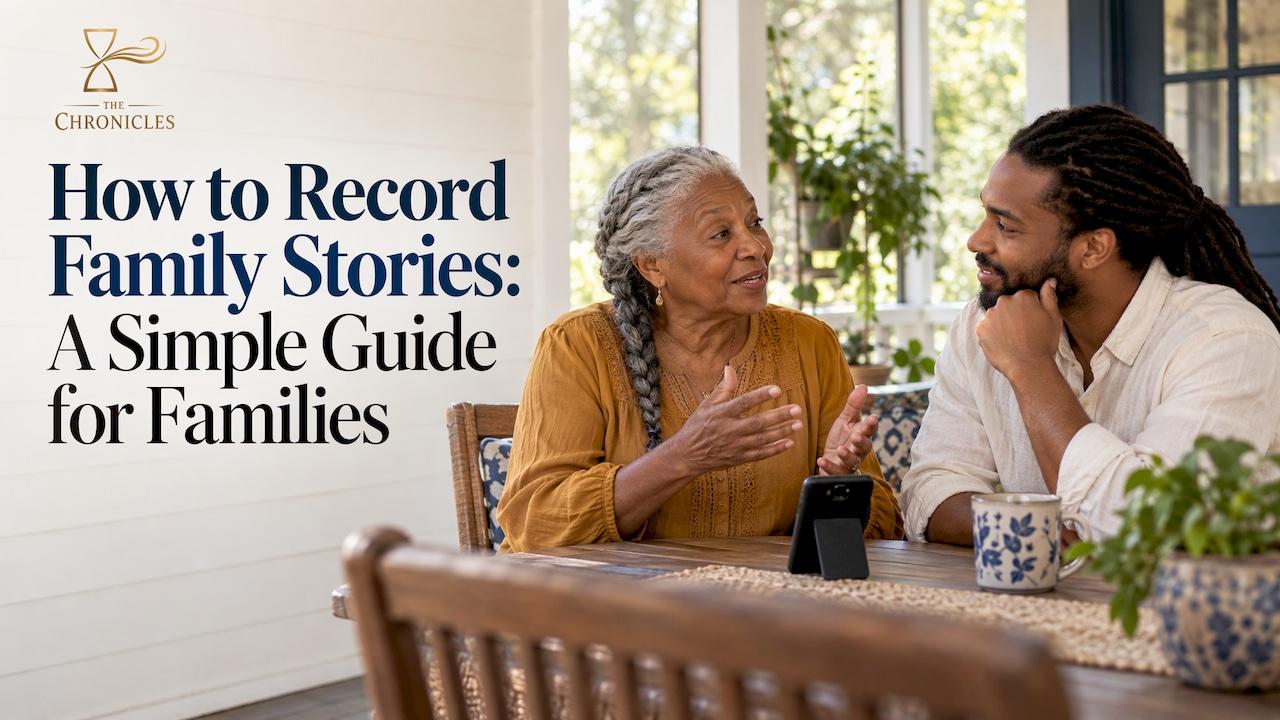
To record family stories, sit down with one person, press record on the phone you already own, ask open questions about their life, and then give the recording a home where the whole family can keep it. The recording is the first half of the job. The second half is turning it into something people will actually read and hear. That is what we built The Chronicles for: photos and memories become narrated chapters your family owns.
This guide walks through both halves, in the order you will need them.
TL;DR
- Start small: one relative, one phone, one quiet room, at least 30 minutes.
- Ask open questions ("Tell me about...") and bring old photos to jog memories.
- Let the storyteller lead, and tell them they can skip any question.
- Keep two copies of every file in two places, and check them each year.
- Turn the recordings into chapters and a printed book so the stories get read, not just stored.
Table of Contents
- Start with one person and one format
- Prepare before you press record
- Questions that open people up
- Record clearly with the phone you already own
- Keep what you record safe
- Turn recordings into chapters your family will read
- Our view
- Start your family's first chapter
- FAQ
- Sources
Start with one person and one format
The biggest obstacle is not equipment. It is the feeling that it has to be done properly. NPR archivist Nicolette Khan says families get hung up on a perfect recording, when the best tool is whatever you can save, keep and share.
Pick the person first. NPR's Yowei Shaw suggests making a list of stories you are curious about and then finding the family "keeper of great stories". It is often a grandparent, but it can be an aunt, an uncle or a parent who always tells the best version of the holiday tale.
Then choose a format that fits them:
- Audio only suits a relative who is camera-shy. The National Genealogical Society's 2025 recording guide suggests offering it for exactly that reason.
- Video captures expressions and hands, and UCLA's Teresa Barnett recommends keeping only the interviewer and the storyteller in the frame for intimacy.
- Phone or video call works for family far away. The same NGS guide notes that distant relatives can be interviewed by phone or Zoom.
- Written answers by email work for people who would rather think and type than talk. Our guided email interviews were designed for relatives who are not comfortable with technology, and they do not need a login.
Talk through the plan beforehand. Explain how you will use and share the recording so your relative feels comfortable saying yes.
Prepare before you press record
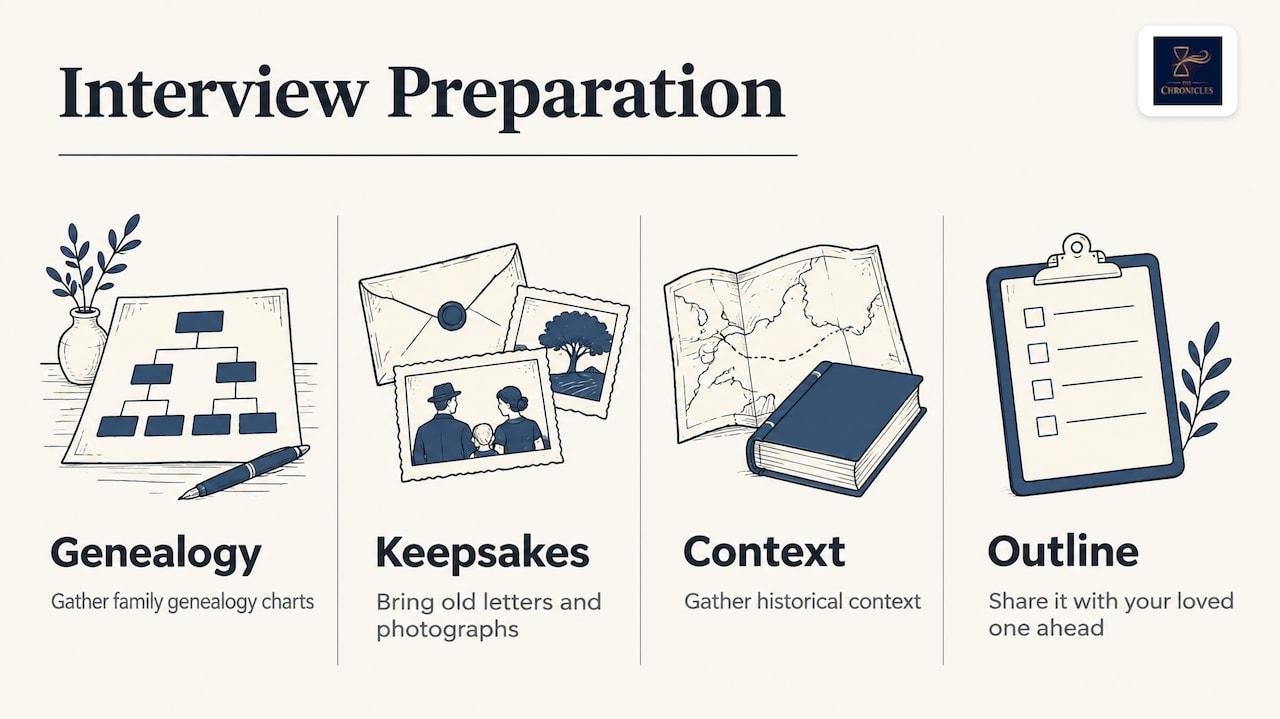
A little homework changes the conversation. Barnett advises gathering genealogy charts, old letters, photos and some historical context, then drawing up an outline and sharing it with your loved one ahead of time. Nobody likes being surprised by a pop quiz about their own life.
The AARP guide to oral family history adds a useful step: brainstorm with as many relatives as you can first. They will tell you which stories, sayings and family jokes they think must be saved.
Ask your storyteller to bring photographs, clippings or documents. The Utah Historical Society's oral history toolkit suggests this to spark memory, and recommends making copies to keep with the recording. A single photo of a kitchen in 1962 can produce twenty minutes of stories.
If you want a deeper walkthrough, our guide to conducting an oral history interview with your family covers the whole process.
Questions that open people up
Short yes-or-no questions get short answers. Barnett recommends open prompts such as "Tell me about...", "Describe..." and "How did it feel when...?", moving in chronological order, and following up with "What do you mean by that?" or "How so?" The Utah toolkit likewise favors questions like "What led up to...?" that draw out what a person thought and felt.
Some starting points for a parent or grandparent:
- What is your earliest memory of home?
- Tell me about the house you grew up in. What did it smell like?
- Describe your first job. How did you get it?
- How did you meet Grandpa, and what did you think of him that day?
- What did it feel like the day your first child was born?
- What did you worry about most in your thirties?
- What do you want the grandchildren to know about you?
Nicolette Khan points out that we tend to tell the same stories over and over. When you hear a familiar one, ask what the person was sensing or feeling at the time. New details usually surface.
Be gentle with hard subjects
A good interview follows the storyteller. The South Carolina preservation toolkit says oral histories are narrator-led and that you should say before recording that they may skip any question or redirect the conversation. It also notes that a question like "Can you tell me about your parents?" can assume a happy family history, so phrase it more openly.
Barnett suggests listening for invitations, such as "That was such a difficult period of my life," rather than springing a painful topic suddenly.
If your parent is in a nursing home or memory unit, keep sessions short and unhurried. Use photographs and familiar objects as prompts, and let the person tell a story in pieces across several visits. Energy and mood vary from day to day, so choose a time of day when they are usually at their best.
Record clearly with the phone you already own
You do not need a studio. NPR's Life Kit calls the built-in smartphone recording app a great option. Its advice:
- Find a quiet room and switch off the TV and the dishwasher.
- Place the phone between you and your storyteller, with the microphone pointed toward both of you.
- Plan for at least 30 minutes.
The NGS guide adds a few practical habits: test your equipment first, bring extra batteries and storage, and take written notes as a backup. At the start, say the date, place and names aloud. The Smithsonian's interviewing guide recommends exactly that kind of short introduction, plus getting permission in advance and explaining what will happen to the recordings.
Spell names and clarify dates at the end, not mid-story. The Utah toolkit says accuracy matters, but an unbroken story matters more in the moment.
Don't edit out the background. Khan suggests capturing a nephew's laughter or a dog's bark as part of the family soundtrack.
For more on the grandparent case, see the best ways to record a grandparent's life story. If you want the sound of a voice to live alongside the words, our audio memory book article shows how.
Nothing about this has to be formal. Recording a story at the kitchen table, on a porch, or while looking at photos is more natural than a staged interview, and relaxed, natural settings tend to produce more genuine moments in family photography too.
Keep what you record safe
A recording sitting on one phone is one cracked screen away from gone. The Library of Congress's personal digital archiving kit gives a clear routine:
- Give files descriptive names and tag them with people and subjects.
- Save audio in an open file format.
- Make at least two copies on different media, kept in physically separate places.
- Check them at least once a year, and make new media copies every five years.
The University of Michigan's guide to personal digital files agrees on at least two backup copies, ideally stored away from the originals.
A raw hour of audio is also hard for a grandchild to browse. Most families never go back to listen. That is why the next step matters.
Turn recordings into chapters your family will read
Stories survive when they are easy to open, share and add to. In The Chronicles, you turn photos and short memories into written chapters, with AI help, in your family's own words. You can add real voice narration, and where a person agrees, consented voice cloning. Several relatives can contribute to the same story over time, and relatives who prefer email can answer guided interview questions without logging in.
When you are ready, chapters can become a printed book. Our guides on turning old family photos into a book and making a digital family scrapbook show the process. If you are preserving stories after a loss, a memorial memory book holds a person's chapters in one place. New parents can start a baby book the same way, one small chapter at a time.
Check privacy and ownership
Before you put your family's stories anywhere, ask who can add, edit and download, and whether you can export everything. Funeral.com's 2026 guide to memory apps suggests asking about export early, naming a backup person who knows where passwords are kept, and keeping sensitive material, such as medical or family-conflict details, in a private space apart from the shared archive.
On The Chronicles, your stories are never used to train AI, you own them, and you can export them. There are no ads and no lock-in.
Our view
Every family has someone whose stories everyone says they will write down someday. We have watched that someday slip away, and it is why we built The Chronicles.
A recording is a beginning. A story becomes part of a family when it is shaped into a chapter, paired with the photo that inspired it, heard in the voice that told it, and handed down in a book. We believe the stories behind the pictures matter most, and that the whole family should be able to add to them, whatever their comfort with technology.
So start this week. One question, one photo, one phone. Then give the story a place to live.
Kevin
Start your family's first chapter
The Chronicles has a Free plan at $0, a Chronicle plan at $7 per month, and a Family plan at $15 per month. Printed books are separate: Paperback from $49 and Hardback from $99. See the plans and gifts or begin on our home page.
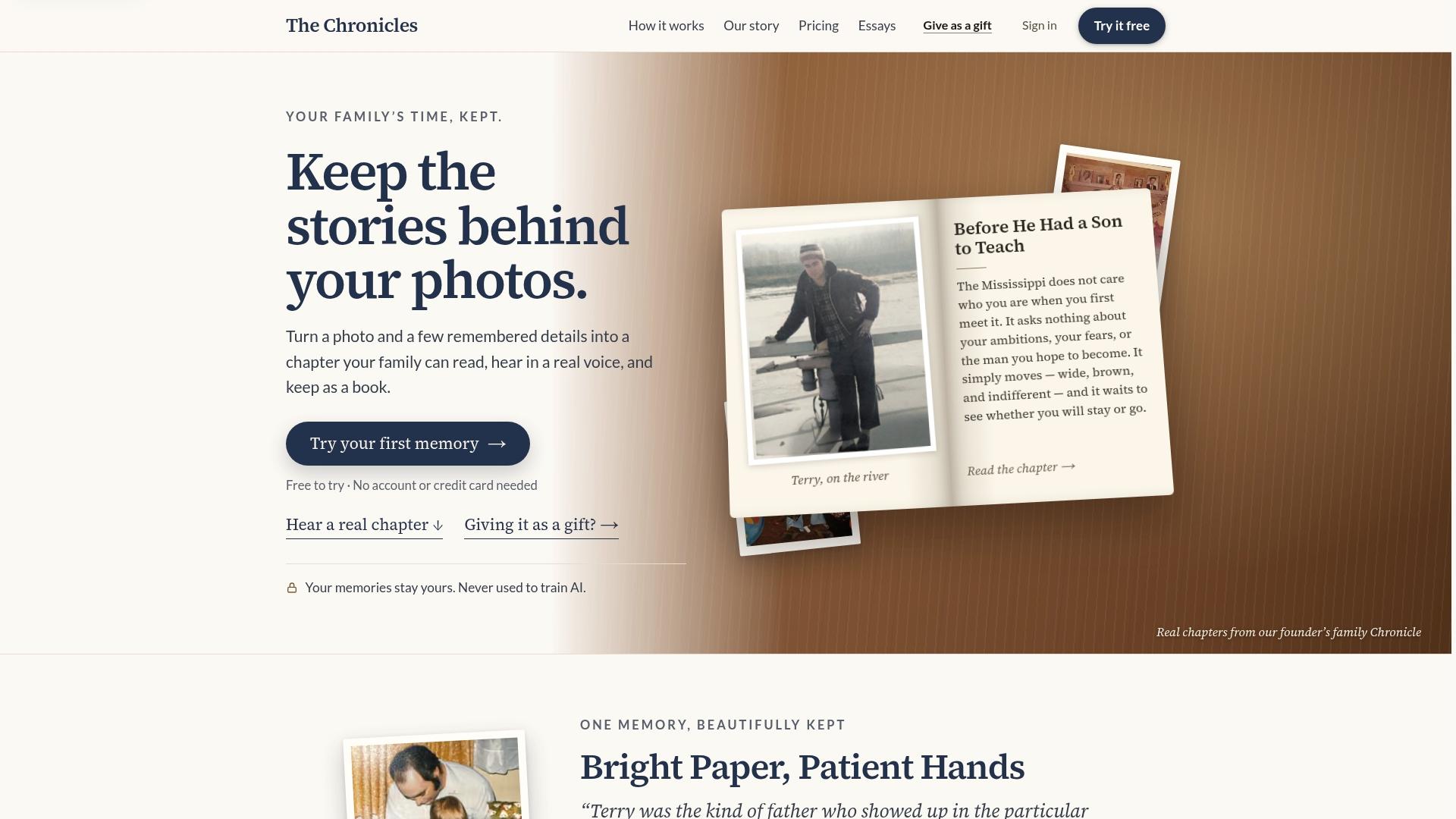
If your first step is a printed keepsake, the book options show both formats.
FAQ
How do I record my parents' life story?
Choose one comfortable setting, bring old photos, and ask open questions in chronological order. Tell your parent they can skip anything. Record in short sessions over several weeks, then gather the best stories into chapters.
What is the best way to record grandparents' voices?
The voice recorder app on your phone is enough. Sit in a quiet room with the phone between you, microphone toward both of you, and plan for 30 minutes or more. Save copies in two places, and add the audio to a voice memory book so the voice stays with the story.
How long should a recording session be?
NPR suggests planning at least 30 minutes. For a relative who tires easily, shorter and more frequent sessions are kinder, and each one can focus on a single photo or memory.
What if my relative is camera-shy or lives far away?
Offer audio only, or do the interview by phone or Zoom, as the NGS guide suggests. Guided email questions are another way for a relative to share stories at their own pace.
Sources
- NPR Life Kit: How to tell family stories
- National Genealogical Society: Record Family Memories 2025
- UCLA Magazine: Preserving Family Histories
- AARP: Create an Oral Family History
- Utah Historical Society Oral History Toolkit
- Smithsonian: The Interview
- How to Record Family Stories (South Carolina toolkit)
- Personal Digital Archiving Day Kit
- Preserving Personal Digital Files (University of Michigan)
- Grief Tech: The Best Apps for Storing Memories in 2026
- Natural Family Photography: What It Is and How to Get It
Recommended
From the founder
Start your first chapter — three minutes, no account.
Drop in a photograph of someone you love. Write three sentences about a moment with them. The Chronicles writes the chapter.
Try it free →Questions or thoughts? kevin@thechronicles.life — I read everything.