← Essays · November 15, 2026 · 11 min read
How to Share Memories After a Loss, Together
Gentle, practical ways to share and collect memories of someone who has died: prompts, how to gather stories from family, and how to keep them in one place.

How to Share Memories After a Loss, Together
The best way to share memories after a loss is to start small and gather them in one place. Ask each person for one specific story, give them a gentle prompt, and keep every answer somewhere the whole family can return to. You do not need to write a eulogy or a book. You need a few honest moments, saved before they fade. We built The Chronicles for this: a place where a family's photos and stories become chapters everyone can read, hear and eventually hold in print.
TL;DR
- Ask for one specific memory at a time, not "tell me everything." Small, ordinary moments are often the ones people treasure most.
- Use sensory prompts: what they smelled like, how their voice sounded, what they said all the time.
- Collect from everyone, including relatives who are not comfortable with technology, and let each person choose when and how much to share.
- Keep it all in one shared place instead of scattered across texts, emails and phone galleries.
- Turn it into a memorial book or chapters when the family is ready. There is no deadline.
Table of Contents
- Why sharing memories helps
- Start with the people, not the project
- Prompts that unlock real stories
- If you are the one writing
- Look in the everyday leftovers
- Ways to bring it all together
- How The Chronicles helps a family gather and keep memories
- A gentle way to start this week
- What it costs to keep the stories
- Our perspective
- Start your family's chapter
- FAQ
- Sources
Why sharing memories helps
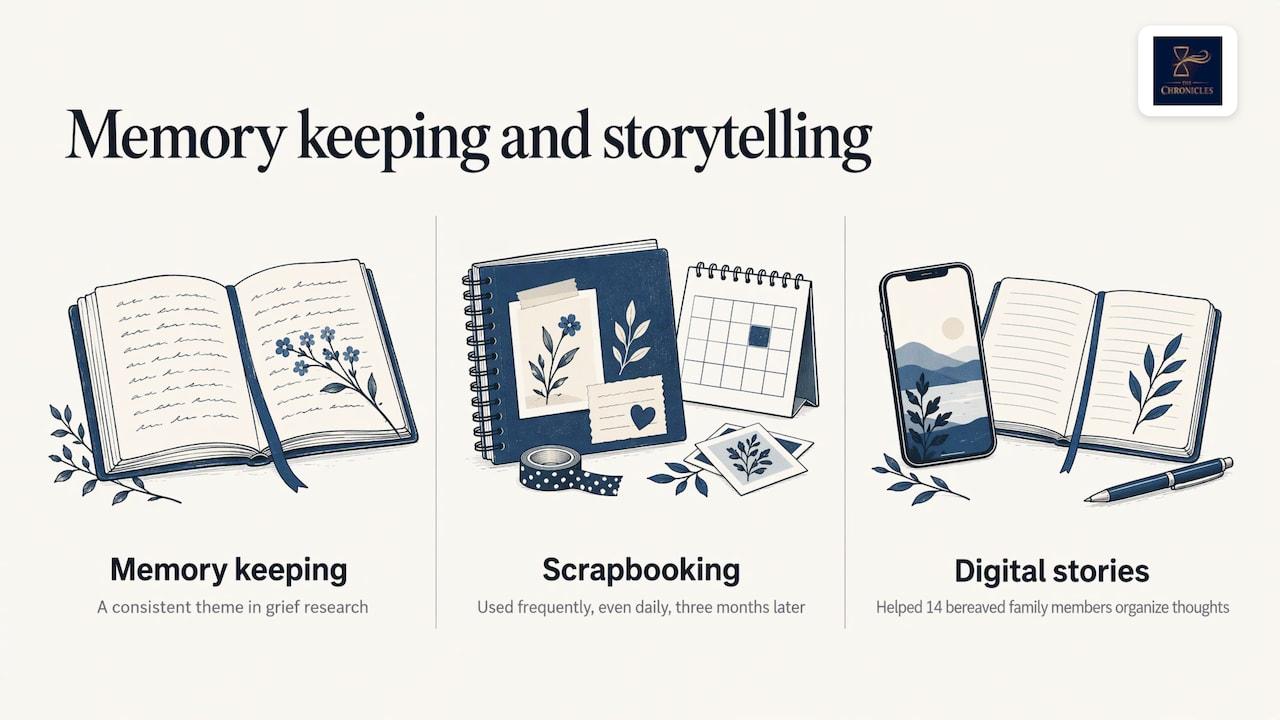
Grief can make a loved one feel as if they are slipping away. Telling their stories is one way families keep them close. Research on memory-keeping and grief describes memory keeping, meaning making and continued bonds with the person who died as consistent themes in grief research. In that same review, grieving adults in a four-week scrapbooking project in Cleveland, Ohio were still turning to their scrapbooks frequently, even daily, three months later.
Storytelling itself can help too. In a peer-reviewed study of 14 bereaved family members, digital storytelling helped participants organize their thoughts and feelings about the loss, gave them more confidence talking about those feelings with others, and served as a source of closure. The authors describe the final sharing as participants re-entering their world with a narrative authored by themselves.
That last idea matters for families. Your story is yours to tell, at your pace.
Start with the people, not the project
Before you collect anything, decide who you are collecting from. For most families that means:
- Siblings, children and grandchildren
- Aunts, uncles and cousins
- Close friends, neighbors and coworkers
- Anyone who knew a different side of the person
Keep the invitation light. A short message such as "If a moment with Dad comes to mind, I would love to hear it" works better than a long request. Grief is personal, and some people are not ready. A gentle approach that respects consent and privacy lets people opt out at any moment, write when they feel ready, or share privately first.
Not every memory will be easy. Some relatives will remember complicated years alongside the good ones. You can leave space for that without forcing anyone to disclose more than they want to, and you decide together what goes into the final keepsake.
Prompts that unlock real stories
Most people freeze when asked for "a memory." Specific prompts make it easy. The Good Grief Project's question ideas include what the person wore, smelled like or sounded like, a first memory, sayings, quotes or jokes, and something no one else may know.
The University of Washington's Memorial Corridor prompts go further, asking people to describe a loved one through all five senses: a favorite perfume or cologne, a favorite food, the sound of their laugh, how it felt to hug them. They also invite a photo of something very mundane, a candid picture, because tiny everyday details often hold the most of a person.
Try a few of these:
- What is your first memory of them?
- What did they always say?
- What was the smell of their kitchen, car or coat?
- What would they do that made you roll your eyes, and now makes you smile?
- How would you like them to be remembered?
That last question comes from the Invisible Histories Memorial Archiving Zine, which also suggests recording short, ten-minute paired conversations between friends.
If you are the one writing
Sometimes the hardest memory is your own. Writers who work with grief offer practical tricks. Jessica Handler, in Modern Loss, suggests pretending you are telling a friend, describing a person's fidgeting habits in a shared scene, or using a song that transports you as a prompt. She also suggests putting off decisions about what makes the final story.
Writer Sadie Hoagland, in Writer's Digest, recommends using small emblematic moments, gestures or objects to stand for the relationship. If a full account feels impossible, start with one object: a coat, a recipe card, a car key.
Look in the everyday leftovers
You may already hold more memories than you think. A New York Times feature described how, after a death, families pore over digital fragments such as text messages, emails, to-do lists, playlists and voicemails, which capture spontaneity and small moments that might otherwise be missed.
Gather the following and set them in one folder:
- Photos, including blurry and candid ones
- Voicemails and voice memos
- Saved texts and emails
- Handwritten recipes and notes
- Cards and letters
Each item can become the starting point of a story. A photo of Grandpa at the grill is a picture. The story of the burned burgers that every cousin still laughs about is a chapter.
Ways to bring it all together
Families have long kept memories in memoirs, scrapbooks, and audio or video. AARP describes one family that asked relatives, friends from their temple and coworkers to each send a favorite memory and a picture to build a memory book.
StoryCorps offers a related approach: families record a conversation about a loved one, with questions chosen in advance, and set the recording to private, community-only or public, changeable at any time.
The trouble with any gathering method is the follow-through. Memories arrive by text, email, voicemail and paper, and someone ends up as the unofficial archivist. That is the problem we designed The Chronicles around.
How The Chronicles helps a family gather and keep memories
The Chronicles turns photos and short memories into written chapters, so a family can build one story together instead of keeping many fragments. A few things matter most when you are grieving:
- Guided email interviews. Relatives who are less comfortable with technology can answer questions by email, and collaboration works without logins.
- Many hands, one story. Multiple family members can add to the same Chronicle over time, so it keeps growing as new memories surface.
- Real voices. Narration can use real voices, including consented voice cloning, so a story can be heard as well as read.
- Memorial books. You can build a memorial memory book, and our guide to making a memory book after someone dies walks through the steps.
- Privacy and ownership. Stories are never used to train AI, and you own your story, with easy export.
If the person you lost was a parent or grandparent whose stories were only partly recorded, our guide to recording a grandparent's life story and the page on grandparent stories may help. If you have a pile of photos, turning photos into stories is a good first step.
A gentle way to start this week
- Pick one photo. Choose a picture that makes you smile, even through tears.
- Write three sentences. Who is in it, where you were, and one thing they said or did.
- Invite two people. Ask one sibling and one friend for a single memory each.
- Add a voice. If someone prefers talking to typing, a short spoken memory can be just as precious.
- Pause. Come back in a week. Nothing here has an expiration date.
When you are sharing with a grieving family, short and sincere beats polished. St. Jude's bereavement guide recommends condolence messages that use the person's name and share one or two specific memories, with no advice or explanations. It notes that families may reread such messages for comfort and to learn stories about their loved one, and it suggests following up on holidays, birthdays and the anniversary of the death.
GriefShare likewise suggests sharing stories and photos on a death anniversary and asking family and friends for theirs. It adds that children can benefit from hearing stories that keep a loved one's legacy alive.
What it costs to keep the stories
The Chronicles has a Free plan at $0, a Chronicle plan at $7 per month and a Family plan at $15 per month, all listed on our pricing page. Printed books are separate: Paperback from $49 and Hardback from $99, one time, on our book page. Free trials are available, so you can begin with a single photo and a single story.
Our perspective
We think the most important thing a family can do after a loss is to write down the small things while someone still remembers them. Not the dates and the résumé, but the way they laughed, the song they hummed, the sentence they always ended with.
Memory is shared. One person holds the kitchen, another holds the road trips, another holds the voice on the phone. That is why we built The Chronicles around many contributors, simple email interviews for relatives who do not want another login, and narration that lets a story be heard.
Your family's stories are not training data. They stay yours, with full ownership and easy export, and no ads and no lock-in. When you are ready, a memorial book turns the chapters into something you can hold.
Kevin
Start your family's chapter
If you are ready to begin, start a Chronicle for free and add the first photo and story. Others can join at their own pace.

FAQ
How do I write about memories of someone who passed away?
Start with one small moment: a gesture, an object, a phrase. Write it as if you were telling a friend, and do not worry about the ending. Writers on grief recommend small emblematic scenes over a full life summary, and you can decide later what belongs in the final story.
What can I say when sharing a memory with a grieving family?
Use the person's name and share one or two specific memories. Keep it short and sincere, and skip advice or explanations. Families often reread these messages, so a specific detail means more than a general comfort line.
How do I collect memories from relatives who are not tech-savvy?
Ask a few specific questions by email or in a short phone call. In The Chronicles, guided email interviews let relatives reply without creating a login, and their answers can become part of the shared chapters.
Is it okay if some relatives do not want to share yet?
Yes. Grief moves at different speeds, and people should be able to opt out or wait. Offer private options, like writing down a memory for themselves first, and let each person decide what joins the shared story.
Sources
- Exploring the Usage of Found Objects in Art Therapy for Bereavement (Lesley University)
- Digital Storytelling as an Intervention for Bereaved Family Members (PMC)
- What To Do When Family Stories Are Not Ready To Share (Reality Pathing)
- Remembering Your Person (Good Grief Project)
- Prompts, Memorial Corridor (University of Washington)
- Memorial Archiving Zine (Invisible Histories)
- How To: Write Your Story (Modern Loss)
- How to Write About Grief (Writer's Digest)
- The Digital Fragments We Leave Behind After Death (The New York Times)
- How to Capture You or Your Loved One's Legacy (AARP)
- Commemorating the Lives Lost During the COVID-19 Pandemic (StoryCorps)
- What to Say After a Child's Death (St. Jude Together)
- 11 Meaningful Ways to Remember Someone on Their Death Anniversary (GriefShare)
Recommended
From the founder
Start your first chapter — three minutes, no account.
Drop in a photograph of someone you love. Write three sentences about a moment with them. The Chronicles writes the chapter.
Try it free →Questions or thoughts? kevin@thechronicles.life — I read everything.