← Essays · November 6, 2026 · 12 min read
Storyworth vs Remento: Which Family Story Book Fits You?
Storyworth vs Remento compared on price, how stories are collected, voice, photos and books, plus a third option if you want chapters written for you.
Storyworth vs Remento: Which Family Story Book Fits You?
Storyworth is the better fit when the storyteller likes to type and a weekly email question feels like a pleasant habit. Remento is the better fit when the storyteller would rather talk than write. If you want a third path, where photos and short memories become written, narrated chapters that the whole family can add to, we built The Chronicles for exactly that.
Below you will find how each service works, what each costs, where they differ, and how to choose for a grandparent, a new baby, or a loved one you are remembering.
TL;DR
- Storyworth is a writing-first service: weekly email questions, written answers, and a printed hardcover book at the end. It is listed at $99 for the subscription, which includes a hardcover.
- Remento is built around speaking your answers, so it suits people who find typing a chore. Reviews commonly list it at about $99 a year, but check its own site for the current plan.
- The real question is not which brand is better. It is whether your storyteller will write or talk, and whether you want one voice or the whole family in the book.
- The Chronicles turns photos and short memories into written chapters, adds real-voice narration, and lets relatives contribute by email without logging in.
- Whatever you choose, get clear consent before recording anyone, and keep your own copy of everything.
Table of Contents
- How Storyworth and Remento work
- Price: what each one costs
- Side by side: where they differ
- Which one is easier for older adults?
- How long does a Storyworth book take?
- Photos, voice and what you keep
- Privacy, consent and memorial books
- Our perspective
- Which one should you choose?
- Try The Chronicles with a few photos
- FAQ
- Sources
How Storyworth and Remento work
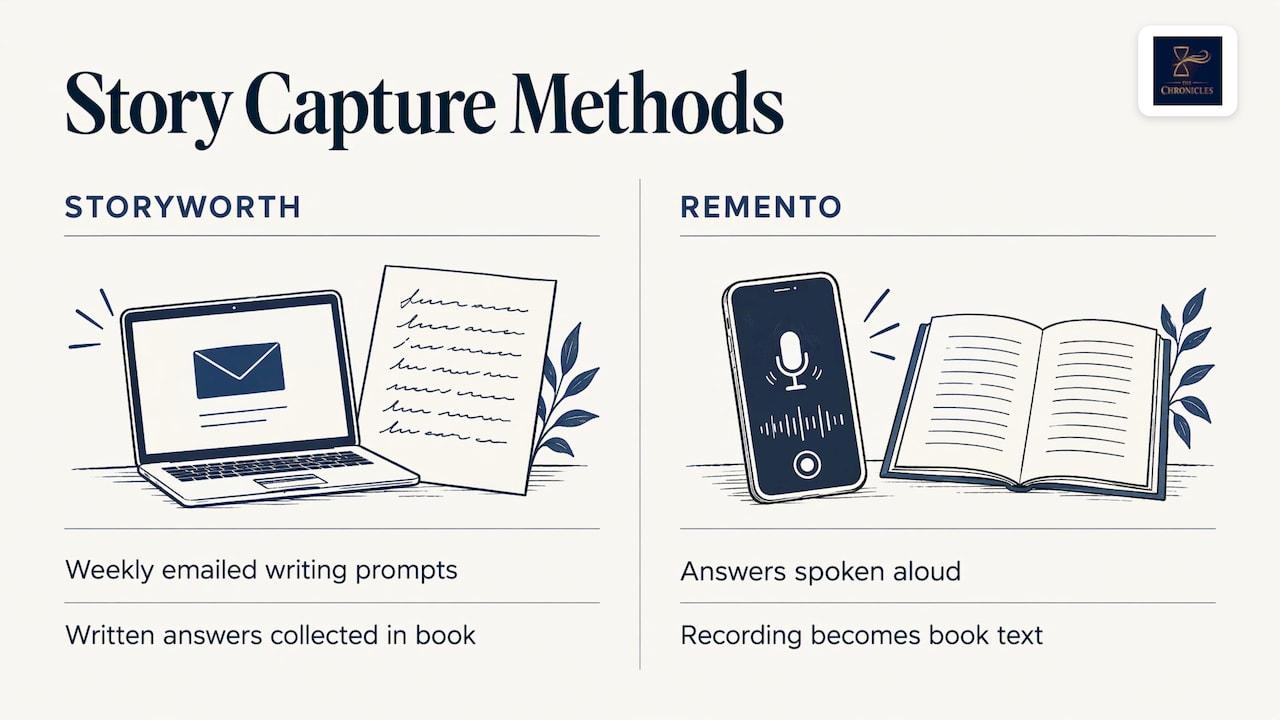
Storyworth: one question a week, written down
Storyworth sends the storyteller a prompt by email each week. They answer in writing, and over a year those answers are gathered into a book. According to one review of the service, the hardcover is a standard 6x9 with a black and white interior, and you also get a PDF to download.
That structure is its strength. A weekly rhythm gives a reluctant storyteller a gentle deadline, and a year of Tuesdays adds up to a real book. It also asks a lot of one person: sit down, remember, and write a few paragraphs, again and again.
Remento: speak the story, get the text
Remento starts from the opposite assumption. Instead of asking a grandparent to type, it lets them answer out loud, then turns the recording into text for the book. Families who tried both often make the switch for exactly that reason. One parent in a caregiving forum thread described getting a Storyworth refund because their mother would rather not write the answers, and moving to Remento at the same price.
Talking is easier for many people over 75. It is also closer to how family stories were always told: at a kitchen table, with a cup of coffee going cold.
Price: what each one costs
The headline numbers are close. Storyworth is listed at $99 with a hardcover included, and Remento is commonly reported at about $99 a year. Because both companies change plans, shipping and add-ons, treat any figure here as a starting point and confirm on each official page before you pay.
When you compare, line up the same things:
- What the subscription includes (prompts, recording, the first book).
- What a second or third copy costs, which matters for a family with several households.
- Shipping, and whether it is added at checkout.
- Whether the book is black and white or full color.
- What happens to your stories if you stop paying.
That last point matters more than it seems. A book is a keepsake, but the stories behind it are the real inheritance.
Side by side: where they differ
| What you care about | Storyworth | Remento | The Chronicles |
|---|---|---|---|
| How stories are captured | Written answers to weekly emailed questions | Spoken answers turned into text | Photos and short memories turned into chapters; guided email interviews for relatives |
| Best for | Storytellers who enjoy writing | Storytellers who would rather talk | Families who want many voices and photos in one story |
| Voice | Text in the book | Spoken answers are central | Real voice narration, including consented voice cloning |
| Who contributes | Mainly one storyteller | Mainly one storyteller | The whole family, with relatives able to reply by email without a login |
| Hardcover included | Printed book | Paperback from $49, hardback from $99 | |
| Ongoing use | A year of prompts | A year of prompts | Unlimited chapters, added over time |
The first three rows tell most of the story. If the person whose memories you want will write, Storyworth works. If they will talk, Remento works better. If the memories live in a shoebox of photographs and in five different relatives' heads, a single-storyteller service starts to feel narrow.
We also keep side-by-side pages if you want more detail: Storyworth vs. Chronicle and Remento vs. Chronicle.
Which one is easier for older adults?
Ease comes down to one question: what does the storyteller already do comfortably?
- They type email every day. Storyworth will feel natural. The prompt arrives in a familiar place and the answer is just a reply.
- They are more comfortable talking. Remento removes the keyboard. This is a real relief for anyone with arthritis, low vision, or a lifetime of avoiding computers.
- They will not touch any technology. Someone else has to do the work. That might be you, sitting beside them with a phone, or a guided email interview where a relative simply replies to questions in their own words.
Our own approach to this is the guided email interview. A less tech-savvy relative gets friendly questions in their inbox and answers them by reply, with no account to create and no password to forget. We designed it for the grandparent who says, "Just tell me what to do."
If you want more ways to capture a life story in person, our guide to recording a grandparent's life story walks through the options.
How long does a Storyworth book take?
People ask how many pages a Storyworth book is and how long they have to finish. The honest answer is that both depend on the plan and on how much the storyteller writes, and the company's current terms are the place to confirm them. What is true in practice is that a weekly prompt over a year asks for steady effort, and plenty of families report that momentum fades somewhere in the middle.
That is worth planning for with any prompt-based service. A few habits help:
- Pick a day and a place, such as Sunday morning with coffee.
- Let the storyteller skip any question that feels flat.
- Add photos early, because a photograph often unlocks a better story than a question does.
- Have a family member read each answer and respond. Being heard keeps people going.
- Save your work somewhere you control, not only inside one app.
The same rhythm applies to Remento, where speaking is quicker, but someone still needs to keep the habit alive.
Photos, voice and what you keep
A book is the end of the process. What you keep along the way matters just as much.
Photos. Storyworth lets you add photos to the book, and the printed interior is black and white according to that review. If your family photos are the heart of the project, check how each service handles them before you commit.
Voice. A grandmother's laugh is not in a transcript. Some services keep only the text. Ask each one whether the original audio stays available to your family, and in what format. We built our voice memory book so chapters can be heard aloud in a real voice, with voice cloning only when the person has consented.
Ownership and export. You should be able to download your stories in full and walk away with them. Our pledge is full story ownership with easy export, and no lock-in.
Privacy, consent and memorial books
Recordings hold more than stories. They hold a person's voice, their health, their regrets, sometimes their address. Before you start with any service, a few checks are worth five minutes.
- Consent. A privacy advocate quoted in a news report on an AI memory startup stressed that families should get clear consent, especially from seniors, because recordings involve intimate details and voiceprints. Sit down with your parent, explain what will be recorded and who will see it, and ask them.
- AI training. Read each company's privacy policy for whether stories are used to train AI. We pledge that your family's stories never are.
- Who can see it. Check whether you can limit a book to named family members.
- After a death. The same report notes that federal law offers no specific protection for posthumous digital assets, and that only eight states have passed laws giving executors access to a deceased person's accounts. Practically, that means you should download copies now and share access with a trusted relative while your loved one is here.
If you are building a memorial, a memorial memory book lets siblings, cousins and friends add their own chapters to one Chronicle, so the picture is fuller than any one person could paint. For a baby book, the same idea works in reverse: parents write the first chapters, and grandparents add theirs.
Our perspective
Most families do not fail to preserve their stories because they do not care. They fail because the process asks too much of one person.
A weekly prompt is a lovely idea, but it puts the whole weight of a family's history on a grandmother's willingness to write every Tuesday. We think the stories behind a family live in more than one head, and more than one shoebox. They live in a photograph on the fridge, in an uncle's version of the same Thanksgiving, in a recipe that was never written down.
That is why we built The Chronicles around photos and short memories, turned into chapters you can read and hear. Relatives who dislike technology can answer a guided email and never log in. Voices stay real, and clones happen only with consent. Your stories are never used to train AI, and they stay yours.
If a service gets your grandfather talking, that is a win, whichever one it is. Our hope is that the book you end up with sounds like your family, not like a template.
Kevin
Which one should you choose?
Use these quick rules.
- Choose Storyworth if the storyteller enjoys writing, wants the structure of a weekly question, and you are happy with a single-voice, text-led book.
- Choose Remento if the storyteller is more comfortable talking than typing and you want their spoken answers to be the starting point.
- Choose The Chronicles if you want photos to lead, several relatives to contribute, real voice narration, and a book that can keep growing after the first print.
And if you are buying a gift, ask yourself who will do the work. A gift that requires an 82-year-old to learn a new habit is a gift with homework. A gift that lets the family do the gathering is one that gets finished.
Try The Chronicles with a few photos
The easiest way to see whether our approach fits your family is to start with one photo and one memory. Our plans run from a free tier to Chronicle at $7 per month and Family at $15 per month, and printed books start at $49 for a paperback and $99 for a hardback, ordered separately.
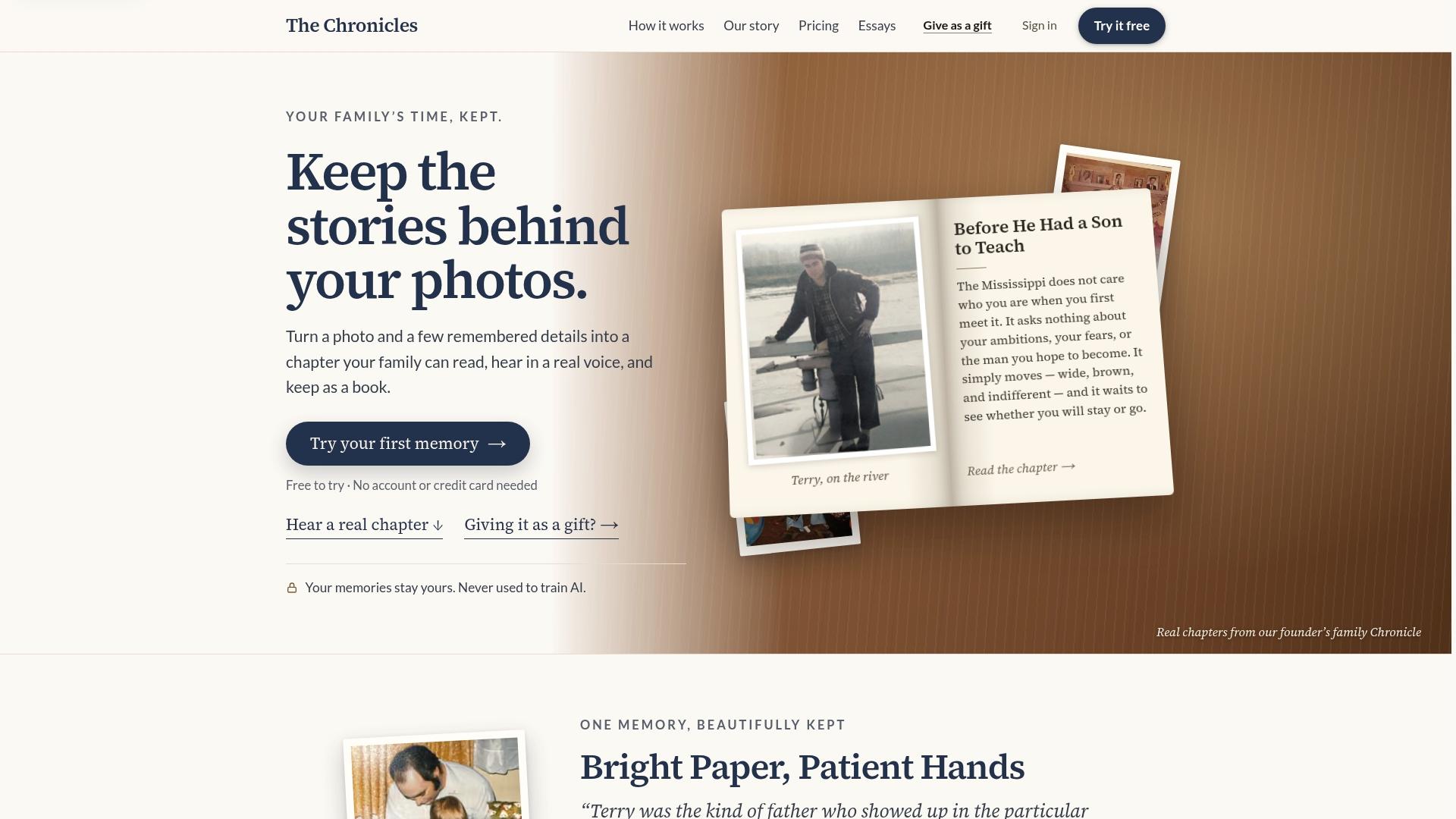
You can start on our home page and add your first chapter today, or see the options on our book page. If photos are where your family's stories live, our AI memoir writer turns each one into a chapter you can edit and share.
FAQ
Is Storyworth or Remento better?
Neither is better for everyone. Storyworth suits people who like to write one answer a week, and Remento suits people who would rather speak their stories. Choose based on how your storyteller is most comfortable, then confirm current plans on each company's site.
How much does Storyworth cost?
Storyworth is listed at $99 for a subscription with weekly email prompts and one hardcover book. Shipping, extra copies and promotions can change the final total, so check the checkout page before you buy.
How do I get a parent who hates technology to take part?
Meet them where they already are. A guided email interview, where they simply reply to a question, asks nothing new of them. You can also sit with them and capture the story by voice, then let the family build chapters around it. Our guide on preserving family stories before they're gone has more ideas.
Can I make a baby book or memorial book with these services?
Yes, though the fit differs. Single-storyteller services work best for one person's life story. For a baby book or a memorial book that many people add to, a platform built for collaboration, like our family legacy book, keeps every contribution in one place.
What should I do before recording a loved one?
Ask for their clear consent, explain who will hear or read the recordings, and keep your own downloaded copy. This matters most for seniors, because recordings can include intimate details and voiceprints.
Sources
- Is StoryWorth Worth It? Price, Comparison, and Review
- A Mark Cuban-backed AI startup is helping families turn conversations with their elderly relatives into lasting memories
- My dad and Storyworth, r/AgingParents
Recommended
From the founder
Start your first chapter — three minutes, no account.
Drop in a photograph of someone you love. Write three sentences about a moment with them. The Chronicles writes the chapter.
Try it free →Questions or thoughts? kevin@thechronicles.life — I read everything.