From The Inman ChronicleJune 1980
Caught Inside the Dark
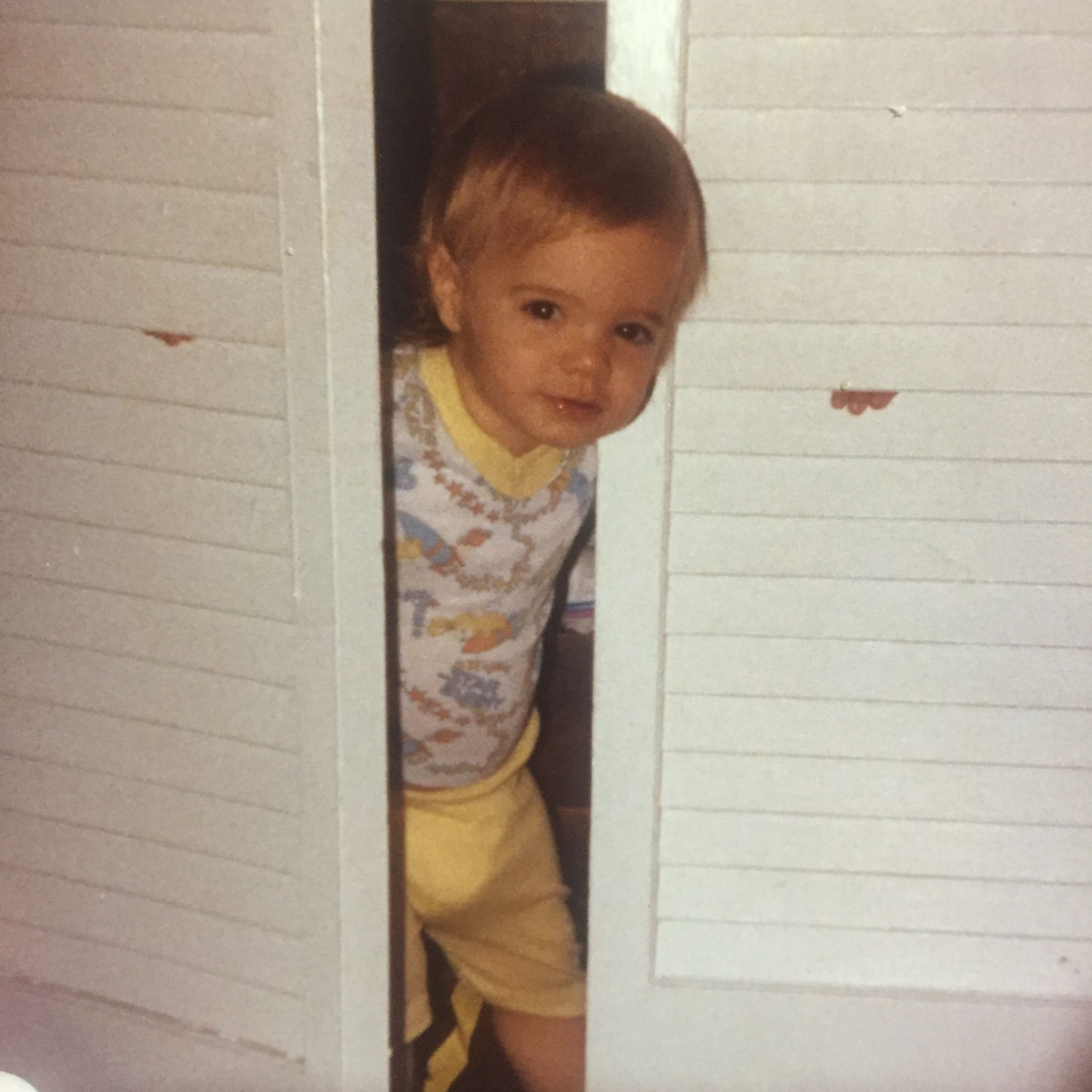
There are photographs that arrive like little time machines, pulling you across decades before you have a chance to brace yourself. This one is Sharon's doing, though she likely didn't think of it that way when she raised the camera in that house on whatever ordinary afternoon it was in Roxana, Illinois, sometime around 1980. She was just catching her boy. And there he is — Kevin, barely two years old, peering through the gap of a bifold closet door with the particular confidence of a child who has not yet learned that hiding and being seen are contradictory aims.
He has wedged himself in the narrow slot between the two panels, yellow shorts and a printed shirt bright against the dim interior behind him, his small face tipped just slightly forward, his eyes holding that look — knowing, amused, proud of himself in the way only a two-year-old can be proud, as though he has discovered something the rest of the world has not yet figured out. The closet door frames him like a portrait, the louvered slats on either side cutting pale stripes across the moment. He is not quite hiding and not quite revealing himself. He is doing something better than either: he is waiting to be found.
This is the house where Kevin grew up, in Roxana, the small town along the Mississippi where the air in summer carried the particular weight of river country and where the rooms held the sounds and smells of a family being built day by ordinary day. Sharon and Terry were making a home there, and Kevin was at the absolute beginning of his understanding of what a home was — that it had closets to disappear into, doors to push through, and always, somewhere nearby, someone who would look up and find you.
There is something quietly remarkable about looking at this photograph now, knowing what comes after it. Knowing that this small boy with his sunny outfit and his gap in the door would grow into a man who would build his own home, full of his own children finding their own closets, their own hiding places, their own thresholds to peer through. Ezra, Bodhi, Holden — each of them has carried in their bones some version of this impulse, that urge to vanish just long enough to be discovered, to press into a small space and wait for the world to come looking. It is not something anyone teaches. It passes through the blood.
What Sharon caught that day was not just her son. She caught something true about him — a readiness, a playful self-possession that would stay with Kevin his whole life. The way he tilts his face toward the camera is not the look of a child who has been surprised. It is the look of a child who was counting on this. Who already understood, at two years old, that someone would come.
You come back to this photograph and find him still there, still waiting in that sliver of light and shadow, still grinning that grin. And it reminds you that every family is really a long series of people finding each other — across years, across thresholds, across the improbable distances of a life that keeps moving forward. Sharon found Kevin in that doorway. Kevin found Kelli. And together they made three boys who have made a whole world of their own hiding-and-finding, their own small revelations pressed through the gaps of ordinary days.
The closet door still has its chipped paint in the photograph, small wounds in the white where years of living have left their marks. The house does not need to be grand to be cherished. It only needs to have held this: a mother with a camera, a boy in yellow, and the whole beautiful ordinary weight of a moment that did not know it was going to last.